May 31, 2014

Jacob Roush and Philip Roush, Virginia Militiamen: 52 Ancestors

Two hundred and thirty-nine years ago (almost to the day), two of my 6th-great-grandfathers took a bold step. The spring of 1775 had brought troubled times to the American colonies. Relations with Great Britain had grown increasingly strained. In early April 1775, the battles at Concord and Lexington confirmed that there was no turning back. The rumblings of discontent had sprouted into outright confrontation, and the American Revolution was underway.

Patriots in Virginia, as in other colonies, quickly formed local militia companies to protect their homes and fight for the cause of American independence. Jacob Roush and Philip Roush were among the men who enlisted in the Dunmore County Militia, under the command of Capt. Jacob Holeman, on May 29, 1775.

I first found evidence of Jacob and Philip’s service as I worked on my application for the Daughters of the American Revolution. The DAR uses the transcription of Jacob Holeman’s enlistment roster in Revolutionary War Records Virginia by Gaius M. Brumbaugh as its source.[1] This is an excellent derivative source, and I’m grateful for it. But as genealogists, we’re urged to seek the original source whenever possible. So that’s what I did when I visited the Library of Virginia during the recent NGS 2014 Conference in Richmond.

Wow. What a thrill to see the list itself! (Even though it’s a negative photostat, and still technically a derivative, it's as close as I’m ever likely to get to the original.) Somehow, holding it made the excitement of that long-ago time, and the power of the commitment these men made, seem like a tangible thing to me. It was no small thing to fly in the face of the royal government and pledge your loyalty to the colonial militia. Their lives, and the security of their families and livelihoods, were on the line.

The two-page document is titled, “A List of the Mens Names in Dunmore County Militia under the Command of Capt. Jacob Holeman.” On the second page, after the names, is the official decree: “By Virtue of the Power and Authority to me given as Lieutenant of the County of Dunmore I do hereby Enlist the with Nam’d Men under the Command of Capt Jacob Holeman. Given under my hand this 29th day of May 1775.”[2] (I’m still working to decipher the flowery signature of the official who signed it.)

A few of my observations about the list, some of which aren’t readily apparent from the transcription in Brumbaugh’s book:
  • The men are listed in three columns. All names on the first page are written in the same clearly legible handwriting; there are no signatures. A few names are crossed out, as though they were later removed from the roster. On the second page are 15 more names, written in a different hand, that appear to have been added after the official declaration.

  • In Brumbaugh’s transcription, the names are in alphabetical order, and the last name is given first (i.e., Roush, Jacob and Roush, Philip). On the original list, the names appear to be in the order that the men presented themselves. They are not in alphabetical order, and the first name comes first, just as it would be said aloud.

  • While many of these men were German, the spellings of their names were anglicized, probably according to how the scribe heard them. Rausch, which morphed into Roush, is spelled Rouse in four places here (brothers Philip, Jacob, Henry, and John Jr.). Zirkle, commonly seen as Circle, is spelled Cirkle (Andrew, Michael, and Peter). The surname Durst, which became Darst in later generations, is spelled Dirst (Abraham and Isaac—Abraham Durst is my 7th-great-grandfather). Clearly, spellings were not yet standardized.

  • Crease lines are evident, indicating the document was folded. A portion of the second page bears the address, “To Capt. Jacob Holman Dunmore County,” as though it was to be delivered to him. (no “e” in Holman in the address)

The Library of Virginia's terms of use preclude me from posting a picture of Jacob Holeman’s List here, and I don’t want to do anything to jeopardize the chances that others have to view, photograph, and copy the document for their personal use. So I’ll share just a small portion of the list where the names of Philip, Jacob, and Henry Roush appear, to give you a sample of the beautiful handwriting. Philip’s name is just above the fold, with some wear evident.


I’ve heard we should seek the original record for the sake of accuracy and completeness. That’s fine and well, but from my experience, I’d add: do it for the sense of connection it gives you. Seeing an original document brings your family history alive in a way that a published transcription simply can’t do. And sometimes that history is just so cool, isn’t it?

--Shelley

© Copyright 2014 Shelley Bishop
The “52 Ancestors in 52 Weeks” series is coordinated by Amy Johnson Crow, CG, author of the blog No Story Too Small.

Related Posts:


[1] Gaius Marcus Brumbaugh, Revolutionary War Records Virginia (1936; reprint, Baltimore: Genealogical Publishing, 1995), p. 607-608.
[2] Shenandoah County, Virginia, Dunmore County Militia Roster, Captain Jacob Holeman’s Company, 1775; accession no. 21127, “Dunmore County Revolutionary War papers, 1775-1814,” Box 53, 2 leaves; Library of Virginia, Richmond.

May 26, 2014

The World War II Memorial: Tribute to a Generation

Family historians practice the concept of remembrance whenever they tell the story of an ancestor’s life. While we research our veteran ancestors year-round, on Memorial Day we also recognize the cemeteries where they rest and the memorials created to their service. On previous occasions, I’ve written about:

On this Memorial Day, I’d like to recognize our country’s striking memorial to the American servicemen and women of World War II. The National World War II Memorial in Washington, D.C. is a beautiful and stirring tribute to those who fought to defend democracy in a terrible war waged on two fronts.


Dioramas leading into the center of the memorial illustrate some of the soldiers’ experiences, starting with enlistment and saying good-bye to loved ones. This diorama depicts the landings on the beaches of Normandy on D-Day, May 6, 1944.


One side of the circular memorial is dedicated to the Atlantic theatre of operations, and the other side to the Pacific. The names of battle sites and operations for each theatre are engraved around low fountains. A colonnade of wreath-adorned pillars—one for each state—rings the perimeter.


Engravings recall memorable quotes by presidents and generals. Some were originally meant to encourage men in the thick of battle, while others, like this one by General Douglas MacArthur, commemorate peace.  


The Washington Monument provides a fitting backdrop for the World War II Memorial. Across the wide expanse of the Reflecting Pool, the Lincoln Memorial stands in silent tribute to the sacrifices of another terrible conflict, the Civil War.


I’ll leave you with this quote from President Harry S. Truman, which summarizes perfectly what we pause to remember every Memorial Day: “Our debt to the heroic men and valiant women in the service of our country can never be repaid. They have earned our undying gratitude. America will never forget their sacrifices.”


May 10, 2014

Photos from the NGS 2014 Family History Conference

Richmond, Virginia, has been buzzing with genealogists all week. Thousands of attendees of the 2014 National Genealogical Society Conference enjoying four days of presentations—and each other’s company—have packed the downtown area. With ten session choices for each time period, a full slate of evening activities, and a busy exhibit hall, there hasn’t been a dull moment.

Since time has been at a premium throughout the conference, I haven’t had much time to write. I thought some photos might be a good way to convey the feel of the event, especially for those not able to attend in person. So here’s a little visual tour from the past three days:


Sessions are being held in both the convention center and the Marriott, just across the street. It felt nice to step out into the sunshine for a few moments while crossing to attend sessions in different buildings.


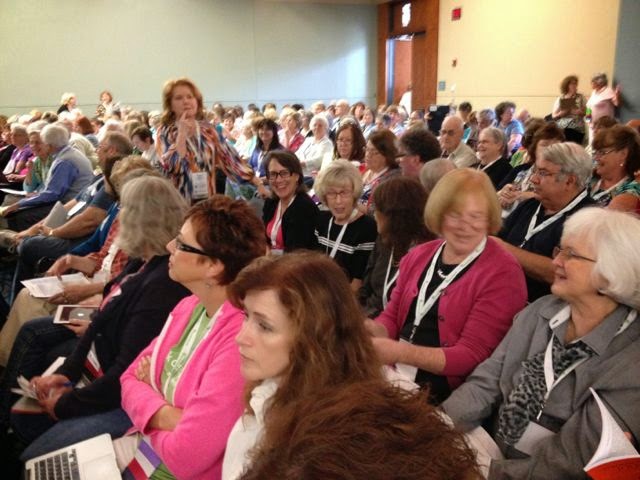
Lecture rooms for the most part have been comfortably full. As expected, though, lectures by Elizabeth Shown Mills and Tom Jones were packed.


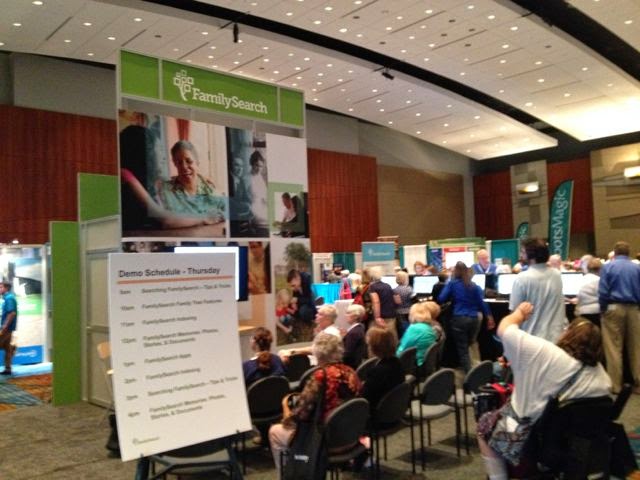
The exhibit hall is spacious and easy to get around. Major vendors like FamilySearch, Ancestry.com, and FindMyPast have large displays with demonstration areas.


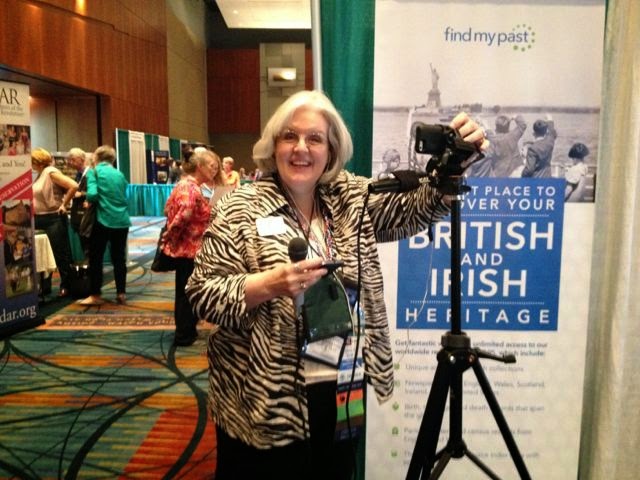
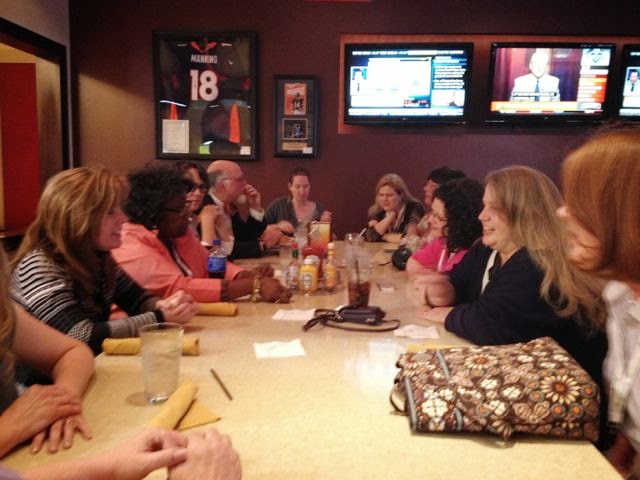
DearMyrtle traveled around the exhibit hall doing spontaneous interviews with her “Ambush Cam.” Here she is in action.


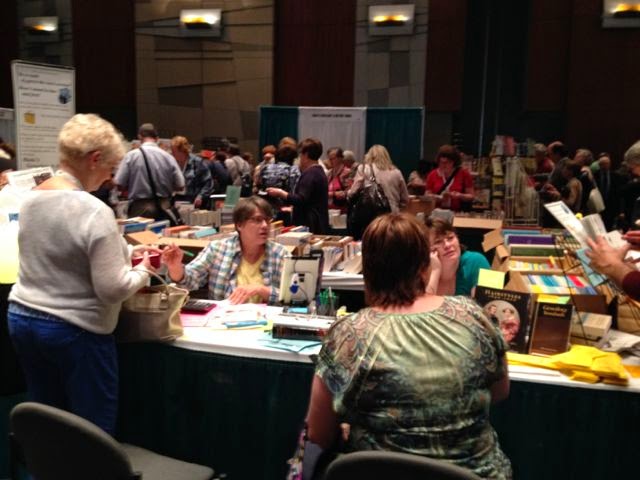
Maia’s Books always draws a big crowd at every conference. Genealogists love books!


At the end of the day, it’s nice to sit and “talk shop” over dinner.

I hope you’ve enjoyed my little photo tour of the NGS 2014 Conference. After I’ve had a chance to rest and recover, I’ll talk a little about some of the sessions I attended, and offer some recommendations for those looking to order lecture recordings on CD. I’ll also talk about some of my research discoveries at the Library of Virginia. But now, I’m off to attend my daughter’s graduation! Signing off from Richmond—

Shelley

April 29, 2014

Researching Catharine (Fox) Roush: 52 Ancestors

Next week I’ll be attending the National Genealogical Society’s 2014 Family History Conference in Richmond, Virginia. I’m particularly looking forward to hearing some of the presentations on Virginia records. I know I have several Virginia ancestors and suspect I may have even more, so I’m also excited about working in some research time at the Library of Virginia while I’m there.

One person I want to investigate is Catharine Fox, wife of Jacob Roush. Jacob served in the Dunmore County Militia under Captain Jacob Holman during the Revolutionary War.[1] (The name of the county changed to Shenandoah in 1778, after the patriotic colonists tired of the British Lord Dunmore.) Although I’ve found a number of records for Jacob, I know much less about his wife Catharine, who is my 6th-great-grandmother. According to DAR records, she was born in 1758 in Berks County, Pennsylvania.[2] I haven’t been able to find a birth or baptism record to verify that information yet, but it’s a clue, at least. Her parents are unknown.

Fortunately, I have found some records naming Catharine:
  • The marriage bonds of Shenandoah County, Virginia, show that Jacob Rausch secured a bond to marry Catharine Fuchsin on 21 February 1775.[3] The record, which I’ve only seen in abstracted form, uses the German spellings of both surnames. (Fuchs is the German word for Fox, and the –in suffix at the end of the name indicates the person is female.) In the absence of a surviving marriage return, I’m following the DAR’s lead in using this as the date of their marriage.

  • The births and baptisms of Jacob and Catharine’s first seven children were recorded in the registry of Old Pine Church in Mill Creek, Virginia. The registry is written in German, but has been transcribed by Klaus Wust.[4] The original book is at the Library of Virginia, and I would love to see it, if it’s not too fragile to handle. The family’s record appears on page 7. One entry in particular intrigues me. The only sponsor for the baptism of Jacob and Catharine’s first child, Rosina, born 20 January 1877, was a woman named Catharina Fuchs. Who was this Catharina? Could she have been the mother, aunt, or cousin of the Catharine Fuchsin who married Jacob Rausch? (Note: Catharine’s name is also spelled Catharina in German records, including the baptism registry.) I think there’s a strong probability of a relationship between the two women of the same name, but I don’t know its exact nature.

  • The Old Pine Church registry also contains an entry for the baptism of Johannes Fuchs, son of Adam Fuchs and his wife Elisabeth, born 19 February 1784.[5] Could this Adam Fuchs be the brother of Catharine (Fuchs) Roush? The surname is uncommon enough to make me suspect so, but as yet I have no proof.

  • The final clue I’ve found to Catharine’s birth family comes from the last known record that she and Jacob created in Shenandoah County. After both of Jacob’s parents died, they moved west and bought land in what is now Mason County, West Virginia, and Gallia County, Ohio. They sold their remaining Shenandoah County land on 9 September 1799 to Peter Fox. Catharine made a mark (X) instead of signing her name.[6] Who was Peter Fox, and might he also have been Catharine’s brother?

Catharine Fox Roush Gallia County Ohio

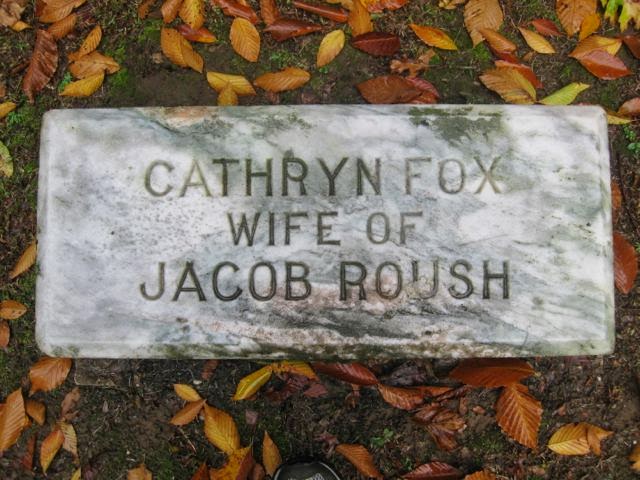
Catharine (Fox) Roush is buried in Roush Cemetery in Cheshire, Gallia County, Ohio. Her date of death is a mystery. I think she may have died relatively early in their residence there, because she did not sign the customary dower release when Jacob sold land in October 1809, or any time thereafter. Jacob wrote a detailed will in January 1827, and Catharine is not mentioned in it.

So where does this leave me? Well, first I need to develop a research focus for Catharine. I’m considering this: "How was Catharine Fox, who married Jacob Roush in February 1775, associated with fellow Shenandoah County residents Catharina Fuchs/Fox, Adam Fuchs/Fox, and Peter Fox?" Then I want to take a good look at the Library of Virginia’s online catalog and determine which resources I want to see next week. And I’d better get cracking—it’s coming up fast!

--Shelley

© 2014, Shelley Bishop

“52 Ancestors in 52 Weeks” is coordinated by Amy Johnson Crow, CG, author of No Story Too Small.


[1] Gaius M. Brumbaugh, Revolutionary War Records Virginia (1936; reprint, Baltimore, Maryland: Genealogical Publishing, 1995), p. 607-609.
[2] Daughters of the American Revolution Genealogical Research System, “Ancestor Search” database (http://services.dar.org/public/dar_research/search/?Tab_ID=1 : accessed 28 April 2014), Jacob Roush of Virginia, Ancestor #A098978.
[3] John Vogt and T. William Kethley, Shenandoah County Marriage Bonds, 1772-1850 (Athens, Georgia: Iberian Press, 1983), p. 243.
[4] Klaus Wust, Old Pine Church Baptisms, 1783-1828, Mill Creek, Virginia (Edinburg, Virginia: Shenandoah History, 1987), p. 19-20.
[5] Ibid., p. 20.
[6] Amelia C. Gilreath, Shenandoah County, Virginia Deed Book Series, Volume 4: Combination Minute Book, 1774-1780, and Deed Books M and N, 1799-1804 (Nokesville, Virginia: privately published, 1989), p. 57; citing Shenandoah County Deed Book M: 47, Jacob Roush to Peter Fox (1799).

Related Posts:

April 22, 2014

Finding John Herrel's Naturalization in an Unindexed FamilySearch Collection

John George Herrel, my great-great-grandfather, was the last of my direct ancestors to immigrate to America. In a previous post, The Joy of Holding History in Your Hands, I wrote about viewing his original declaration of intention to become a U.S. citizen. The declaration indicates he left the port of Le Havre, France, on 7 August 1880, and arrived in New York City on 29 August. He was a 21-year-old native of Germany. It was filed with the Hamilton County, Ohio, Probate Court on 25 March 1881, less than a year after his arrival.

John George Herrel

Until last week, however, I had not been able to find John’s certificate of naturalization, which would show he completed the citizenship process. Thanks to a cooperative effort between Hamilton County government offices and FamilySearch.org, thousands of early Cincinnati records have recently been digitized and made freely available online. It took a bit of perseverance, but I’m happy to report that I found John’s naturalization record.


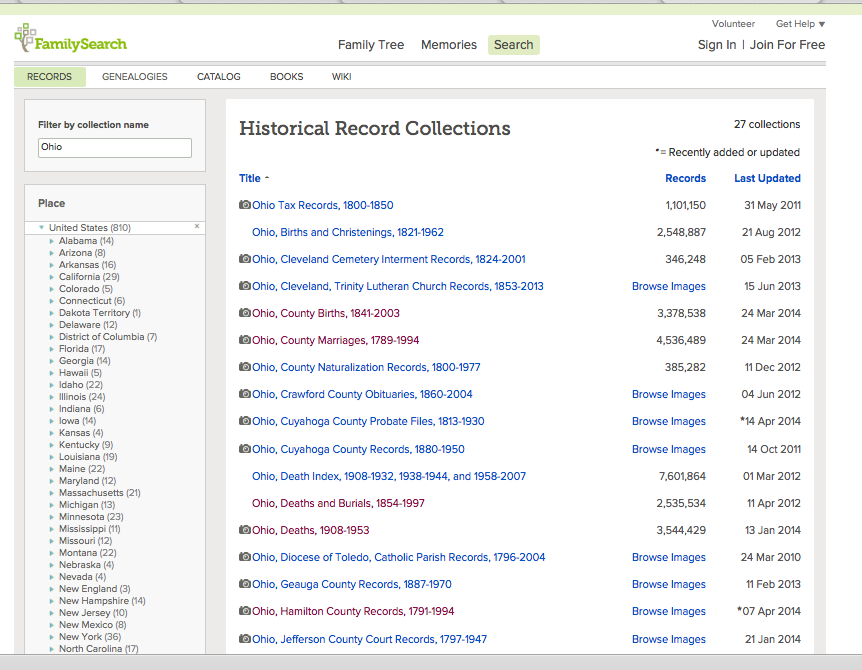
The new FamilySearch.org collection, “Ohio, Hamilton County Records, 1791-1994,” is not indexed, so simply entering John’s name in the main search box won’t bring up his naturalization. What do you do when the records you need aren’t indexed? To help others looking for records in browse-only FamilySearch collections, I thought I’d share the process I used, step by step:


1. From the FamilySearch homepage, choose Search. Scroll down to the bottom of the page where you see a map of the world. Under “Browse All Published Collections,” click on United States.

2. In the box “Filter by Collection Name,” enter Ohio. In the list that appears, scroll and select “Ohio, Hamilton County Records, 1791-1994.” You’ll note it says Browse Images—a sign that the collection is not indexed.


3. Read the description of the collection, then click on “Browse through 1,151,606 images.” (Don’t worry, you won’t have to look at them all!)
You’ll see the collection includes Land and Property Records, Probate Records, Naturalization Records, and Vital Records. Choose Naturalization.

4. A long list of choices will be displayed. Since I already have John’s declaration of intention, I can bypass those. Based on my information, I started with “Petitions for Naturalization, vol. 5, 1884-1885.”

5. The volume opens on Image 1. The first several pages of the volume contain an alphabetical index. Scroll through these using the arrow next to the image number box until you find the H page (for Herrel). In time, I learned the H index usually appeared about Image 9, so as a shortcut, I could enter 9 in the box and click Go. You’ll see there are no Herrels indexed in this volume. To go back to the list, click on “Naturalization Records” in blue.


6. I repeated this process for Petitions for Naturalization volumes 6, 7, and 8. I didn’t find a single Herrel indexed in any of those volumes, which initially discouraged me. But wait, there’s more! Keep scrolling down and you’ll find “Petitions for Naturalization, vol. A-1, 1884-1894.” This appears to be another ledger kept by a different courtroom or judge. Alas, there are no Herrels in this volume, either. I went back to the list and tried vol. A-6 and vol. A-7 (there’s no mention of vols. A-2 through A-5), again without results.

7. Finally, I hit paydirt with “Petitions for Naturalization, vol. A-8, 1884-1885.” There he was: Herrel, John, page 227. Now I needed to find what image number corresponds to page 227. Entering 227 in the image box number took me to ledger page 101, so I needed to go much higher. By trial and error, I found page 227 at image 479. Success at last! I checked the next page, too, but John’s record is only a single page.


John Herrel naturalization Cincinnati

See what I mean by perseverance? Browsing through unindexed collections may take more time and effort, but it’s not hard to do, and the results are worth it. In fact, it took me a lot longer to write this blog post than it did to search the indexes of all eight volumes one by one.

Now I know John Herrel stood before a judge in Hamilton County, Ohio, to take his oath and become a citizen of the United States on 28 September 1885. What a proud moment that had to be for him and his family. Of course, I’d be happier today if the record stated the name of the town in Germany he came from, but I have to remember that wasn’t why the record was created. The court only needed to know he had fulfilled the requirements for citizenship and renounced his allegiance to the Emperor of Germany.

The bottom line is that browse-only collections like these on FamilySearch hold many untold treasures. Don’t be afraid to give them a try!

--Shelley

Citation for this record: “Ohio, Hamilton County Records, 1791-1994,” digital images, FamilySearch (www.familysearch.org : accessed 8 April 2014), Petitions for Naturalization, vol. A-8, 1884-1885, no. 227 (image 479), John Herrel, issued 28 September 1885; Hamilton County Probate Court, Cincinnati.

“52 Ancestors in 52 Weeks” is coordinated by Amy Johnson Crow, CG, author of No Story Too Small.

Related Posts:

April 20, 2014

Easter Wishes


This little girl with her hands full of bunnies is my mother, Judy Herrel, at Easter 1945. Isn’t she adorable? As we collect memories and keepsakes of years gone by, we naturally find our favorites. This photograph is one of mine.


Happy Easter to my Mom, and to all my readers and friends!
--Shelley

LinkWithin

Related Posts Plugin for WordPress, Blogger...