Showing posts with label DNA Testing. Show all posts

February 2, 2015

Learning About Genetic Genealogy, Part 2

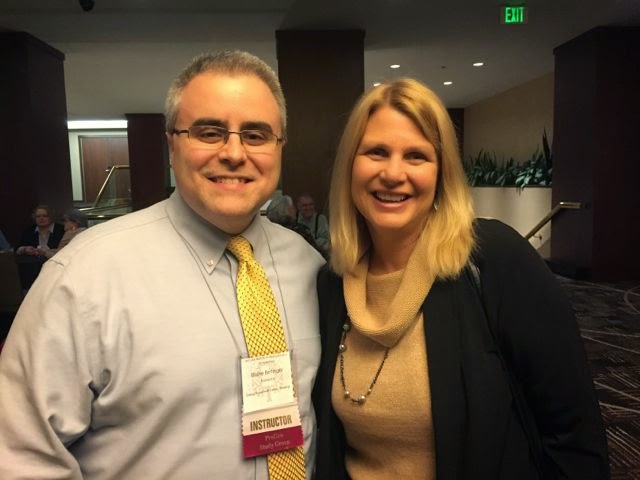
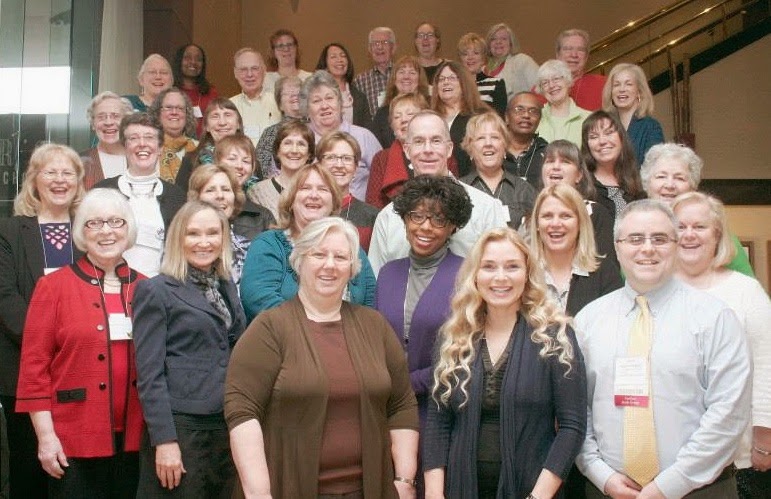
Class at SLIG 2015, front row, left to right: Debbie Parker Wayne, CeCe Moore, Blaine Bettinger

Last week, I wrote about some of my experiences in the Salt Lake Institute of Genealogy (SLIG) course, Getting Started with Genetic Genealogy. My post on Learning About Genetic Genealogy, Part 1 talked about our coverage of mtDNA (direct maternal line), Y-DNA (direct paternal line), and X-DNA testing.

CeCe Moore, one of the nation’s leading genetic genealogists, took us into the intricacies of autosomal, or atDNA, testing and analysis the latter part of the week. And what a fascinating field it is.

Autosomal DNA is valuable for genealogy because it looks at chromosome segments inherited from all ancestral lines—your whole pedigree chart. The big caveat in this is random recombination. That’s the process by which bits of your mother’s genes and bits of your father’s genes randomly mix together to create an unique individual: you. It’s why sisters and brothers share a significant amount of, but not all, traits and chromosomes.

Because of recombination, you may inherit relatively large segments of chromosomes from one ancestor, and small segments from another. Each generation, the bits get smaller, and eventually some don’t make it to you at all. So in effect, some ancestors five or six generations ago drop off your genetic pedigree chart.

AtDNA analysis for genealogy, therefore, becomes a matching game. Who among other testers matches you on a specific chromosome segment, and how does that help you identify your most recent common ancestor (MRCA)?

CeCe talked about identifying close matches by centiMorgan size, chromosome mapping, and triangulation. She discussed the methodology for working with match data on Family Tree DNA, 23andMe, and AncestryDNA. We talked about the special challenges of working with endogamous (self-contained) populations, such as Ashkenazi Jews. CeCe also shared some moving stories of the successes she has had using atDNA to identify parents of adoptees and others with an unknown birth parent.

Blaine Bettinger offered tips for using third-party tools to aid in analysis, with a special focus on GEDmatch. I found this very helpful and wished we had even more time to spend on third party tools. Blaine also discussed privacy, regulation, and ethical issues, introducing the new Genetic Genealogy Standards announced just days earlier.

One of my favorite lectures of the week was Blaine’s presentation on ethnicity, admixture, and kinship analysis. Ethnicity predictions, while far from an exact science, are one of the most intriguing components of DNA testing. Everyone who has tested in my family, at least, is curious to know where their long-ago ancestors came from.

On the last morning, Debbie Parker Wayne talked about when and how to incorporate DNA testing with traditional research to meet the Genealogical Proof Standard, and offered some citation models.

If this course sounds like something you might be interested in taking, I have good news for you. A similar course will be offered twice this summer at the Genealogical Research Institute of Pittsburgh (GRIP), and again at SLIG next winter. Here are the details:

Practical Genetic Genealogy with Debbie Parker Wayne, CeCe Moore, and Blaine Bettinger: at GRIP, June 28-July 3, 2015, in Pittsburgh. Registration begins WED., FEBRUARY 4, at 12:00 noon Eastern time at www.gripitt.org.

Practical Genetic Genealogy with Debbie Parker Wayne, Patti Hobbs, and Blaine Bettinger: at GRIP, July 19-24, 2015, in Pittsburgh. Registration begins WED., FEBRUARY 18, at 12:00 noon Eastern time at www.gripitt.org.

Beginning Genetic Genealogy coordinated by Blaine Bettinger: at SLIG, January 11-15, 2016, in Salt Lake City. Registration begins June 20 at 11:00 am Eastern time at www.SLIG.ugagenealogy.org.

One tip: to get the most out of an intensive study opportunity like this, it’s helpful to come in with some experience under your belt. Read about genetic genealogy, test yourself and some family members at the major testing companies, and attend any webinars, conference lectures, or local seminars on DNA you can find. That will help you catch onto the concepts more quickly, and recognize how you can apply various processes to your own research. You might start by exploring Blaine Bettinger’s blog, The Genetic Genealogist.

Just like regular genealogy, DNA research can be both time-consuming and addicting. So don’t say I didn’t warn you. Now if you’ll excuse me, I have some matches to investigate…

-Shelley

Related Posts:

January 29, 2015

Learning About Genetic Genealogy, Part 1


Earlier this month, I spent an exciting (and exhausting!) week at the Salt Lake Institute of Genealogy (SLIG). My brain is full of new information about genetic genealogy, and my flash drive is full of new records about my ancestors. I enjoyed reconnecting with friends who share my passion for family history, as well as meeting new people.

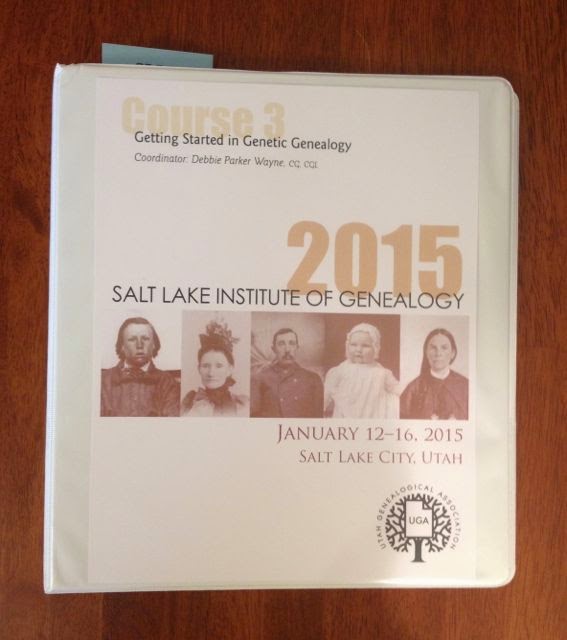
I took the course “Getting Started in Genetic Genealogy,” coordinated by Debbie Parker Wayne, CG, CGL. Blaine Bettinger, PhD, JD, and CeCe Moore also instructed significant sections. The three of them made a good team, and we covered a lot of ground. The binder of handouts we received will make a great resource going forward.

Many people have asked me what the course was like, and whether I’d recommend it. The answer to the latter is definitely yes. First of all, SLIG is an incredibly well-organized institute, the new hotel facilities are good, and the people couldn’t be nicer. Still, the true test of a course is in its content and instructors, and I’m happy to say this one delivered on both counts.

We started out with an overview of DNA testing and basic genetics, talking about the different tests and the “big three” companies: Family Tree DNA, 23andMe, and AncestryDNA, as well as specialty testers. We spent some time the first day learning some scientific vocabulary. I now understand terms like centiMorgans, alleles, recombination, pseudo-segments, and endogamous populations, not to mention MCRA, CRS, IBD and IBS. Not sure of the difference between a SNP and a STR? Neither was I before this course.

Debbie Parker Wayne covered mitochondrial (mtDNA) testing, and what it can reveal about your direct maternal ancestry far back into history. Crucial to this is understanding that a mother passes her mtDNA to all her children, but only daughters can then pass it on to the next generation.

While using mtDNA to solve genealogical problems for recent generations can be challenging, we talked about ways of approaching it. For one thing, mtDNA can often be used to either support or refute a supposed relationship. It also can be used to prove questions of Native American ancestry through the mother’s line. For me, a key point in our mtDNA discussion was understanding more about haplogroups, which indicate where your maternal ancestors originated many hundreds of years ago.

Y-DNA also deals with deep ancestry, but on the opposite side of the pedigree chart. Only males inherit a Y chromosome, so Y-DNA passes from father to son through many generations, with occasional small changes. These changes, or mutations, can provide big clues for families. Blaine Bettinger presented an excellent discussion of the advantages and limitations of Y testing, using Y-DNA results, finding Y-DNA cousins, surname projects, STR markers, haplotypes and haplogroups. He told us about some third-party databases and tools for analyzing results, and showed how Y-DNA can be used to identify whether two males share a common paternal ancestor.


We also learned about X-DNA, which is tied to the sex chromosomes. A female inherits one X chromosome from her mother and one from her father. A male inherits an X chromosome from his mother but none from his father (he gets a Y instead). Because of its more complicated inheritance pattern and the fact that it hasn’t been studied as much, X-DNA often gets overlooked. In the right situations, though, it can be used to narrow down the ancestral lines you should focus on.

In addition to lectures, we did in-class projects designed to identify individuals on a pedigree chart who could be tested for a common ancestor. One takeaway from this was that when you start to work with DNA, those collateral relatives—your grandfather’s brother’s kids, your grandmother’s aunt’s kids, and cousins of every stripe—become vitally important. I have a renewed sense of how valuable it is to include these collaterals in my traditional genealogical research.

That's a quick overview of our first two days. I'll talk about what we covered the rest of the week in my next post, and tell you about opportunities to take a similar course at GRIP and SLIG. There was just too much happening to fit it all into one!

--Shelley

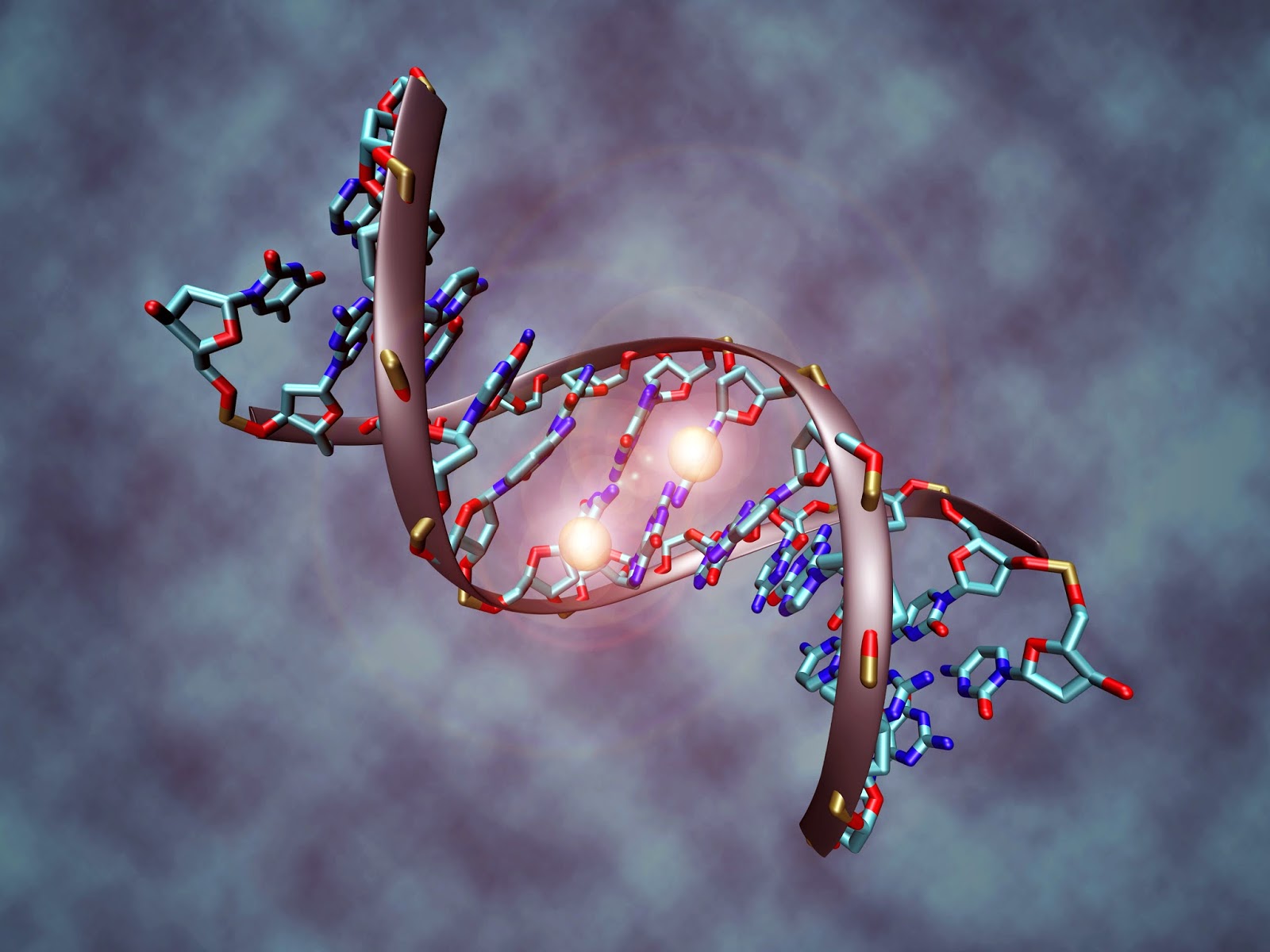
DNA image: "DNA methylation" by Christoph Bock (Max Planck Institute for Informatics) - Own work. Licensed under CC BY-SA 3.0 via Wikimedia Commons - http://commons.wikimedia.org/wiki/File:DNA_methylation.jpg#mediaviewer/File:DNA_methylation.jpg

December 30, 2013

Final Days for Family Tree DNA Sale


Here’s a quick reminder that there are just two days remaining in the Family Tree DNA holiday sale. If you’ve been thinking about ordering a DNA test kit for yourself or someone in your family, you might want to take advantage of these special prices, good through midnight CST on December 31, 2013:

Family Finder: $99, including a Restaurant.com voucher worth $100. Family Finder is an autosomal DNA test, which looks at your genetic makeup “to provide you a breakdown of your ethnic percentages and connect you with relatives descended from any of your ancestral lines within approximately the last 5 generations,” according to the company's website. It’s good for both males and females. The voucher, which can be delivered immediately via email or shipped with the test kit, brings your net cost down to zero—a great deal if you like to eat out! (The test price itself will continue to be $99 after January 1.)

Y-DNA 37: $119 (discounted from $169). Available only for males, Y-DNA tests give results regarding the ancestral origins of your direct paternal line (father, father’s father, father’s father’s father, and so on). If you’re a female, you can ask your father, brother, father’s brother, or male cousin or nephew with your surname to take the test. Check to see if there’s a surname project you can join (they’re free) for help with finding genetic cousins. 

Full mtDNA: $169 (discounted from $199). Both males and females can use the mtDNA test to reveal the ancestral origins of their direct maternal line (mother, mother’s mother, mother’s mother’s mother, and so on) deep into history.

Combination tests are also on sale, as are upgrades if you’ve tested previously but want to refine your results. If you tested your autosomal DNA with another company and would like to upload your data to Family Tree DNA, the cost is now only $49. I did this with my Ancestry.com test results.

Family Tree DNA test kit (from website)
I’ve ordered several of these tests for family members in the last couple of weeks. I’m not affiliated with Family Tree DNA in any way and haven’t received anything for mentioning their sale, but I recommend the company. The sale prices are displayed on the Family Tree DNA home page, so you can't miss them. No coupon or promotion code is necessary. Testing simply involves scraping the inside of your cheek for a minute or so. It's quick and painless.

If you’d like to know more about genetic genealogy, I suggest you follow The Legal Genealogist, written by Judy G. Russell, to keep up with DNA news and other genealogy-related issues. She's summarized recent developments in "2013 Look-Back: DNA." Her blog is a wealth of information, and always an excellent read.

--Shelley

LinkWithin

Related Posts Plugin for WordPress, Blogger...