Showing posts with label Herrel. Show all posts

October 22, 2014

Happy Campers at Boy Scouts Camp Ro-Fre-Lo, 1929: Wordless Wednesday


My grandfather, Freddy Herrel, is the fellow in the center of this troop of Boy Scouts (with his hands on his buddy’s shoulders). It looks like they’re having fun, doesn’t it? I love the wide-brimmed hats.

Fred dated the photo 1929 and labeled it “BSOA Camp Ro-Fre-Lo” in his scrapbook. He was 15 years old. It looks like the cabins are closed up for the winter, so the troop may have been there to help with the opening or closing. My guess is it was taken in November, March, or early April, because the trees are bare.

A Google search for Camp Ro-Fre-Lo didn’t give me any results, and I couldn’t identify it on this list of America’s Oldest Boy Scout Camps. Freddy lived in the German Village community of Columbus, Ohio, and his troopmates probably hailed from the same area. So I imagine the camp was in Ohio, Kentucky, or western Pennsylvania. The name he gave may be short for a longer one. Does anyone know where this camp might have been?


--Shelley

April 22, 2014

Finding John Herrel's Naturalization in an Unindexed FamilySearch Collection

John George Herrel, my great-great-grandfather, was the last of my direct ancestors to immigrate to America. In a previous post, The Joy of Holding History in Your Hands, I wrote about viewing his original declaration of intention to become a U.S. citizen. The declaration indicates he left the port of Le Havre, France, on 7 August 1880, and arrived in New York City on 29 August. He was a 21-year-old native of Germany. It was filed with the Hamilton County, Ohio, Probate Court on 25 March 1881, less than a year after his arrival.

John George Herrel

Until last week, however, I had not been able to find John’s certificate of naturalization, which would show he completed the citizenship process. Thanks to a cooperative effort between Hamilton County government offices and FamilySearch.org, thousands of early Cincinnati records have recently been digitized and made freely available online. It took a bit of perseverance, but I’m happy to report that I found John’s naturalization record.


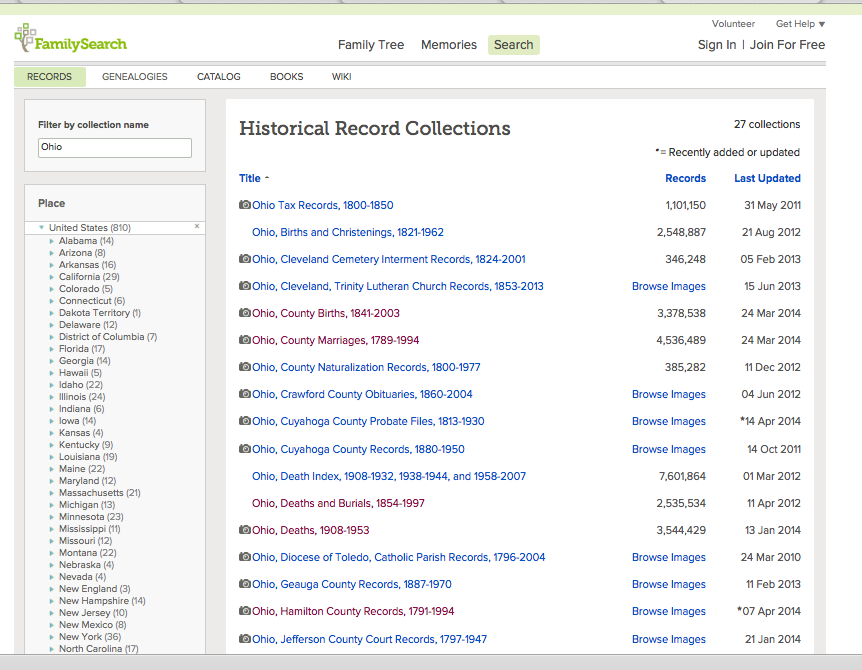
The new FamilySearch.org collection, “Ohio, Hamilton County Records, 1791-1994,” is not indexed, so simply entering John’s name in the main search box won’t bring up his naturalization. What do you do when the records you need aren’t indexed? To help others looking for records in browse-only FamilySearch collections, I thought I’d share the process I used, step by step:


1. From the FamilySearch homepage, choose Search. Scroll down to the bottom of the page where you see a map of the world. Under “Browse All Published Collections,” click on United States.

2. In the box “Filter by Collection Name,” enter Ohio. In the list that appears, scroll and select “Ohio, Hamilton County Records, 1791-1994.” You’ll note it says Browse Images—a sign that the collection is not indexed.


3. Read the description of the collection, then click on “Browse through 1,151,606 images.” (Don’t worry, you won’t have to look at them all!)
You’ll see the collection includes Land and Property Records, Probate Records, Naturalization Records, and Vital Records. Choose Naturalization.

4. A long list of choices will be displayed. Since I already have John’s declaration of intention, I can bypass those. Based on my information, I started with “Petitions for Naturalization, vol. 5, 1884-1885.”

5. The volume opens on Image 1. The first several pages of the volume contain an alphabetical index. Scroll through these using the arrow next to the image number box until you find the H page (for Herrel). In time, I learned the H index usually appeared about Image 9, so as a shortcut, I could enter 9 in the box and click Go. You’ll see there are no Herrels indexed in this volume. To go back to the list, click on “Naturalization Records” in blue.


6. I repeated this process for Petitions for Naturalization volumes 6, 7, and 8. I didn’t find a single Herrel indexed in any of those volumes, which initially discouraged me. But wait, there’s more! Keep scrolling down and you’ll find “Petitions for Naturalization, vol. A-1, 1884-1894.” This appears to be another ledger kept by a different courtroom or judge. Alas, there are no Herrels in this volume, either. I went back to the list and tried vol. A-6 and vol. A-7 (there’s no mention of vols. A-2 through A-5), again without results.

7. Finally, I hit paydirt with “Petitions for Naturalization, vol. A-8, 1884-1885.” There he was: Herrel, John, page 227. Now I needed to find what image number corresponds to page 227. Entering 227 in the image box number took me to ledger page 101, so I needed to go much higher. By trial and error, I found page 227 at image 479. Success at last! I checked the next page, too, but John’s record is only a single page.


John Herrel naturalization Cincinnati

See what I mean by perseverance? Browsing through unindexed collections may take more time and effort, but it’s not hard to do, and the results are worth it. In fact, it took me a lot longer to write this blog post than it did to search the indexes of all eight volumes one by one.

Now I know John Herrel stood before a judge in Hamilton County, Ohio, to take his oath and become a citizen of the United States on 28 September 1885. What a proud moment that had to be for him and his family. Of course, I’d be happier today if the record stated the name of the town in Germany he came from, but I have to remember that wasn’t why the record was created. The court only needed to know he had fulfilled the requirements for citizenship and renounced his allegiance to the Emperor of Germany.

The bottom line is that browse-only collections like these on FamilySearch hold many untold treasures. Don’t be afraid to give them a try!

--Shelley

Citation for this record: “Ohio, Hamilton County Records, 1791-1994,” digital images, FamilySearch (www.familysearch.org : accessed 8 April 2014), Petitions for Naturalization, vol. A-8, 1884-1885, no. 227 (image 479), John Herrel, issued 28 September 1885; Hamilton County Probate Court, Cincinnati.

“52 Ancestors in 52 Weeks” is coordinated by Amy Johnson Crow, CG, author of No Story Too Small.

Related Posts:

April 20, 2014

Easter Wishes


This little girl with her hands full of bunnies is my mother, Judy Herrel, at Easter 1945. Isn’t she adorable? As we collect memories and keepsakes of years gone by, we naturally find our favorites. This photograph is one of mine.


Happy Easter to my Mom, and to all my readers and friends!
--Shelley

April 8, 2014

Fred Herrel, Curtiss-Wright Production Soldier: 52 Ancestors

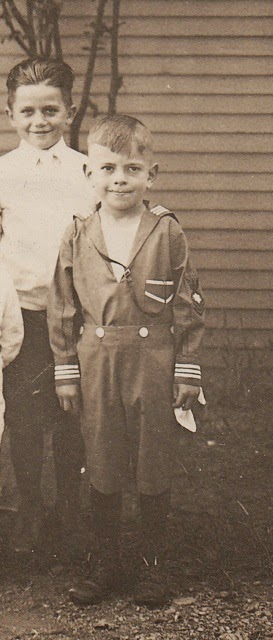
Herb and Freddy Herrel
My grandfather, Frederick C. Herrel, grew up in the shadow of one Great War and spent his 20s in the midst of a second. Born May 20, 1914, to parents Harry and Mabel (Seeley) Herrel, he looked every bit the little soldier in a family portrait taken in Columbus, Ohio, about 1920[1] (although I’d like to know the story behind that haircut!).

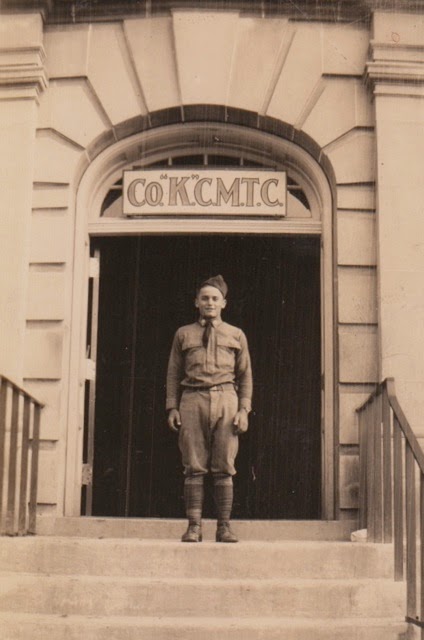
As a high school student between the wars, in the summers of 1930 and 1931, Fred attended Citizen’s Military Training Camp (CMTC) at Fort Knox, Kentucky. At Fort Knox, he and the other CMTC boys drilled, trained, and lived like soldiers. He pasted photos of Fort Knox in his scrapbook, along with pictures of his sweetheart, Wilma Steele.

Fred Herrel, CMTC at Fort Knox, 1930

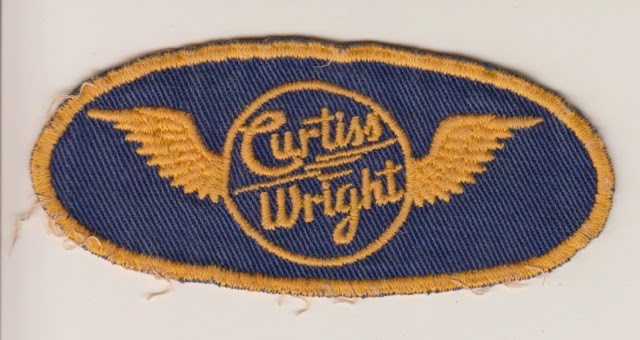
After they married in 1935, the mechanically-minded Fred found employment at Curtiss-Wright, which had a production plant on the east side of Columbus.
Fred was 27 years old when the Japanese bombed Pearl Harbor. His country needed men, and he already had some training. But unlike most in his generation, he never enlisted in the Army or Navy. Why? That’s a question future generations might wonder, too.

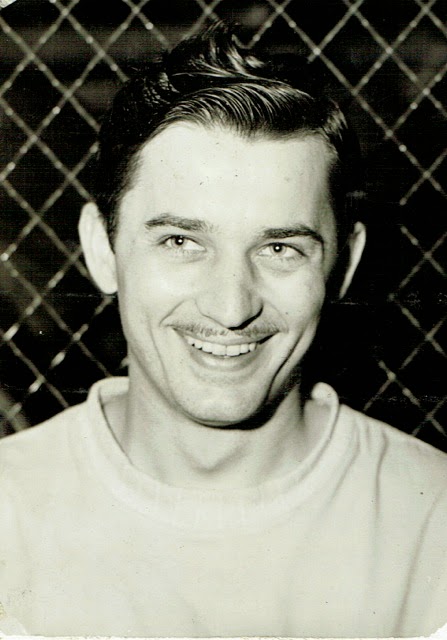
Fred Herrel, about 1940

The answer's pretty simple, really. As war production ramped up, Fred’s skills made him more valuable on the home front than on the battlefield. Curtiss-Wright received major defense contracts for airplanes and airplane parts during World War II, and skilled workers were in high demand. The company would produce over 29,000 airplanes by the time the war ended.[2]

Fred Herrel’s specialty was installing airplane windshields. Production of new aircraft and parts at the Columbus facility was in high gear, but there was a big need for those who could repair damaged aircraft, too. For about six months during the war, he was transferred to a facility in Arizona, where he replaced windshields on planes that had already seen action.

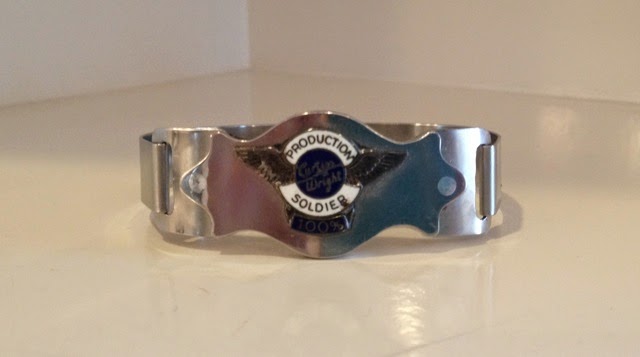
For his contributions to the war effort, Fred received a metal bracelet, which reads, “Production Soldier Curtiss Wright 100%.” It’s a small token of a different type of service than he might have expected back in his CMTC days. So much history packed into one small object.


Fred continued to work for Curtiss-Wright’s successor at the Columbus plant, North American Aircraft/Rockwell International, until he retired. I wish now that I had asked him about those wartime days, and thanked him for the work he did, while I had the chance.

--Shelley

© Copyright 2014 Shelley Bishop
The “52 Ancestors in 52 Weeks” blog series is coordinated by Amy Johnson Crow, CG, author of the blog No Story Too Small

[1] Ohio Department of Health, birth certificate no. 63201 (1914), Frederick Calvin Herrel; Division of Vital Statistics, Columbus.
[2] Curtiss-Wright Corporation, Company History (1939-1948) (http://www.curtisswright.com/company/history : accessed 8 April 2014).

February 18, 2014

52 Ancestors: Minnie King Steele, the Oldest Ancestor I've Known


Some little girls like getting all dressed up in stiff crinoline skirts and fancy velveteen dresses, with bows in their hair and shiny new shoes. Let me say for the record right here that I wasn’t one of those girls. Apparently, I gave my mother quite a hard time when she tried to make my little toddler self look appropriately elegant for a once-in-a-lifetime family photograph. I was not impressed. Then.

But I am now.

The idea to take a five-generation picture started with my grandma, Wilma Steele Herrel. She wanted a photograph that included her own grandmother, Minnie King Steele, as well as her young granddaughter. It was timed around some family occasion—perhaps her own September birthday—in 1961. My mother remembers that on the appointed day, everyone gathered at the home of Wilma’s father, Homer Steele, in Columbus, Ohio. She thinks Wilma’s brother-in-law, Merle Rhoten, a professional photographer, most likely took the picture.


And so, a moment in time was captured. Five Generations, 1961: from left to right, my mother, holding me; my grandmother, Wilma Lucille Steele Herrel; my great-great-grandmother, Minnie L. King Steele; and my great-grandfather, Homer Burdell Steele.

I have no memory of my great-great-grandmother, but clearly she knew me, and today I marvel that our lives overlapped. Minnie L. King was born November 23, 1873, in the town of Cheshire in Gallia County, Ohio.1 Her father, Newel King, was a Civil War veteran, having served in the 91st Ohio Volunteer Infantry, Company B. Her mother, Electa Roush King, was descended from a line of Roush patriots from Virginia’s Shenandoah Valley.


Minnie King grew up in Cheshire, along the Ohio River in the southernmost part of the state. She had many Roush aunts, uncles, and cousins on the West Virginia side of the river, in Mason County. That may have been where she met her husband, George Phelps Steele, who lived in Mason County. She married George on 17 January 1893 in Meigs County, Ohio, when she was 19 years old.2

Minnie and George had two sons, Homer (in the picture) and Walden Steele. By 1900, the family had moved north to Columbus, where they rented a home on the city’s south side and George worked at a steel mill.3 George passed away in 1925, and Minnie lived the rest of her life as a widow. During her later years, she lived with her sister, Bella King Stickelman, in Dayton. Because of this, my mother called her “Grandma Dayton.”

Mom remembers Minnie as being a really nice person, always friendly, cheerful, and optimistic. She was an impeccable and fashionable dresser, with a good sense of style. A cute little black terrier was her constant companion.

Minnie was 87 years old when the five-generation picture was taken in the fall of 1961, and turned 88 in November. I don’t know whether she had been showing signs of not doing well, but it’s good that my grandma insisted on getting the picture when she did. Minnie died shortly afterwards, on December 13, 1961.4

To think that I was held and loved by someone born in 1873, the daughter of a Civil War soldier, amazes me now. Minnie is the oldest ancestor in any of my family lines that I've actually known. She was the only great-great-grandparent still alive when I was born. At the time, of course, I had no inkling of the family history that one photograph could represent, or how much it could mean to me decades later.

I just wanted out of that stiff, scratchy skirt.
--Shelley

  1. Gallia County, Ohio, Birth Records, v. 1: 117, no. 13, Minnie King (born 1873); Probate Court Office, Gallipolis.
  2. Meigs County, Ohio, Marriage Records, v. 9: 102, George Steel and Minnie King (1893); Meigs County Museum, Pomeroy.
  3. 1910 U.S. census, Columbus Ward 1, Franklin County, Ohio, population schedule, ED 37, p. 2B, dwelling 40, family 41, George P. Steele; digital image, Ancestry (www.ancestry.com: accessed 18 August 2009); citing NARA microfilm publication T624, roll 1180.
  4. Ohio Department of Health, death certificate no. 86054 (1961), Minnie L. Steele; Office of Vital Statistics, Columbus. 

© Shelley Ballenger Bishop 2014

This is one of a series of family history stories written for “52 Ancestors in 52 Weeks,” coordinated by Amy Johnson Crow, CG, author of No Story Too Small.

Related Posts:

May 12, 2013

On Mothers


On this Mother’s Day, I count myself incredibly fortunate to have two wonderful women in my life: my Mom, whose love and belief in me has never wavered, and my mother-in-law, who has opened her heart to me as a fourth daughter. I appreciate both of them beyond words. I also cherish the memories of my grandmothers, Nora (Eberhard) Ballenger and Wilma (Steele) Herrel, whose stories, songs, and traditions provided much of the basis for my interest in family history.

And on Mother’s Day especially, I count my blessings for the ones who define my own role as a mother. I have three great kids who constantly amaze, amuse, occupy, challenge, delight, and enrich me. They are the heart and soul of my life. While I don’t talk about them much here on my blog, they’re always on my mind, and I’m so proud of each of them.


Of course, generations of mothers have shared this kind of joy in their children. I think one of the benefits of being a genealogist isn’t just learning to find information, analyze evidence, and draw sound conclusions. It also lies in something less tangible, which is feeling—and valuing—the links that bind one generation to another. From past to present to future. I hope that quality is part of the legacy I’m weaving for my kids—something that helps them know who they are, and where they came from. To me, as a mom and a family historian, that feels like something worthwhile.

Happy Mother’s Day to all!
--Shelley

March 30, 2013

Wilhelmina Mueller Herrel: A Fearless Female


Wilhelmina Carolina Mueller, my great-great-grandmother, spent most of her life in a country far from the one she originally called home. She was born on Christmas Eve, December 24, 1859, in Germany.(1) Family tradition holds that she came from Bavaria. The picture below, showing her with two of her grandsons, was taken about 1911-1914 in the German Village neighborhood of Columbus, Ohio.

Wilhelmina Mueller HerrelIn 1880, when she was 20 years old, Wilhelmina immigrated to the United States.(2) I have yet to find her on a passenger list or immigration record. I presume she came as part of a family group, but because Mueller is a common surname and I don’t know the names of any other family members, and women who married did not have to apply for naturalization, I have little to go on. I also don’t know if she knew her future husband before she came to America. What I do know is that she settled in the large German community in Cincinnati, Ohio. On January 25, 1883 at St. Peter’s Evangelical Church in that city, she married Johann George Herrel.(3)

John and “Mina” Herrel made their home in Cincinnati, where he worked as a carpenter, for the next 20 years. She became a U.S. citizen by virtue of her husband John’s naturalization, about 1890. Mina bore ten children, according to the 1910 U.S. census.(4) I have only been able to account for seven of them to date: Otto, Harry, Albert, Amelia/“Melie”, Edith, Bertha, and Frank Herrel. I believe two of the others were little girls who died young, but the identity of the tenth child is a mystery. Melie also died of diphtheria at a young age.

The family moved to Columbus between 1900-1910. They lived in a home on Sycamore St. in German Village for over two decades. John established a business, John Herrel & Sons, making wooden refrigeration cabinets. Over the years Mina picked up the language of her adopted country, and in both 1910 and 1920 the census taker indicated she could read and write English. Her place of birth in all records found to date was noted simply as “Germany.”

Wilhelmina Mueller Herrel died October 7, 1933 at the age of 73. Her son Otto, the informant for her death certificate, put “unknown” for both her father’s and mother’s name. Her obituary in The Columbus Dispatch gave no clue as to her parents or where she began her life. It read simply: "HERREL—Wilhelmina C., 73 years, widow of John Herrel, [died] Saturday night. Survived by sons Otto J., Harry F., Albert W., and Frank M.; Daughters Mrs. Edith Weber, Mrs. Bertha Carter, all of Columbus; 11 grandchildren. Funeral services in residence, 431 Sycamore St., Wednesday, 2 p.m. Interment East Lawn by the Edward E. Fisher Co."(5)

I still have many unanswered questions about Mina. Who were her parents? What town in Germany was she born in? What were the names of her other children? And finally, what was she like? Was she a good cook? I wish I had thought to ask my grandpa, Fred Herrel, to tell me about his grandmother when I had the chance. From the photograph, she looks kind and motherly. In fact, she is smiling in most of the photos I’ve seen of her—a rarity in the days when solemn portraits prevailed.

I consider Wilhelmina Mueller Herrel a “fearless female” because of the strength and hard work it must have taken to come to a new land, learn the customs and language, and raise a family. I hope that as time goes by I will find new clues to help answer some of the questions I have and come to know her a little better.

--Shelley

Written for Lisa Alzo’s “Fearless Females” blogging series, as part of Women’s History Month. Lisa does a wonderful job writing about her ancestors and helping others do the same at her blog, The Accidental Genealogist.

(1) “Ohio Deaths 1908-1953,” digital image, FamilySearch (www.familysearch.org: accessed 23 April 2009), certificate no. 55927 (1933), Wilhelmina Herrel; citing original records, Ohio Department of Health, Ohio Historical Society, Columbus.
(2) 1920 U.S. census, Columbus Ward 3, Franklin County, Ohio, population schedule, E.D. 57, p. 1B, dwelling 18, family 18, John Herrell; digital image, Ancestry (www.ancestry.com: accessed 25 June 2009), citing NARA microfilm publication T625, roll 1380.
(3) St. Peter’s German Evangelical Church (Cincinnati, Ohio), “Copulationen, Confirmanten, St. Peters Germeinde, Angefangen 1874,” p. 152, Johann Herrel and Mina Mueller marriage (1883); FHL microfilm #1514064, citing original records held by Wright State University, Dayton, Ohio.
(4) 1910 U.S. census, Columbus Ward 1, Franklin County, Ohio, population schedule, E.D. 29, p. 3B, dwelling 73, family 74, John Herrel; digital images, Ancestry (www.ancestry.com: accessed 23 June 2009), citing NARA microfilm publication T624, roll 1180.
(5) Wilhelmina Herrel obituary, Columbus Dispatch (Columbus, Ohio), 9 October 1933, p. 6A, col. 8.

November 24, 2012

Instant Replay: A Big Game for the Big Day

In honor of today’s big game, in which the undefeated Ohio State Buckeyes will take on the Michigan Wolverines and officially close out their 2012 season, I’ve decided to replay one of my favorite family history stories. I hope you’ll enjoy it, no matter what football team you might root for or what the big rivalry is in your town.


Fall means football season in cities across America, and in Central Ohio, football means the Ohio State Buckeyes. And in that realm, there is no greater rivalry than the OSU-Michigan game, which traditionally ends the season each November. So what happens when you throw a wedding into the mix?

The story of my grandparents' wedding begins the year before, in the fall of 1934. With the country in the throes of the Great Depression, times were tough on the south side of Columbus. Wilma Steele’s family lived in a rented house in German Village, where her father worked in a glass factory. She had recently graduated from South High School and was working as a bookkeeper for White Castle, the first chain restaurant in the nation. Years later, she would recall:

Wilma Steele, 1935
 “Your grandfather and I met in the fall of 1934. My best friend, Jerry Jenkins, arranged a blind date for me. We met her friend Neil Palsgrove and Fred Herrel at Walgreen’s on State St., next to the Ohio Theater when the boys ushered. I thought he was cute and he thought the same about me.

“We would go to my Christian Endeavor meeting at South Church of Christ, and then sometimes go square dancing at Georgesville. I would meet him after he ushered and we would go to the midnight show and then to Clyde’s Diner… I had four brothers at that time and one sister. I would get so mad because my parents let them stay up late and we would have no privacy.”

Fred Herrel also lived in German Village, where his family made wood cabinets for commercial refrigerators. He was a couple of years older than Wilma, and had also graduated from South High, although they never dated in school. He, too, was living in a house full of brothers—three of them—and working two jobs didn’t leave him much spare time.

By fall 1935, Wilma turned 19 and Freddy was 21. They had been dating for a year, and were old enough in the eyes of the law to do what they wanted. And they wanted to get married. But weddings require money and parental approval, both of which were in short supply. So on November 23, 1935, Wilma and Fred eloped to Circleville, about 25 miles away. That day happened to be the day of the OSU-Michigan game, which was being played in Ann Arbor and broadcast on Columbus area radio stations. They didn’t pick the day with the game in mind, but the two events would be forever linked for them.

Wilma remembered, “We got married at the parsonage of the Methodist church in Circleville. That day was one of the most exciting Saturdays of my life. The minister was listening to the OSU football game and shut it off only long enough for us to say ‘I DO!’”

The newlyweds had a whole city to rejoice with. The Buckeyes beat the Wolverines 38-0, thereby tying Minnesota for the 1935 Big Ten conference title.

Fred & Wilma Herrel on their wedding day

Foregoing a honeymoon, the new Mr. and Mrs. Frederick Herrel quietly returned to their jobs and their own families. They kept their marriage a secret for six months, until they could get things in order for a life together. “We bought furniture and rented an apartment at 1486 Hunter Ave., and then announced our marriage in March 1936,” Wilma recalled. “Our dream for the future was to get a home of our own.”

Wilma and Fred went on to celebrate 66 anniversaries and follow the Buckeyes through 66 more matchups against Michigan. They were devoted fans the rest of their lives, and rarely missed a game on radio or TV. But none was more exciting than the one on their big day in November 1935.

Go Bucks!
Sources:
Personal history and quotations: Grandmother’s Book (New York: Dellwood Books, 1984), filled out by Wilma Steele Herrel and presented to the author, Christmas 1989.
Ohio State football history: “1935 Ohio State Buckeyes Football Team,” Wikipedia (www.wikipedia.com: accessed 31 October 2011).


Originally published at A Sense of Family on November 1, 2011. Copyright 2011 Shelley Bishop.

LinkWithin

Related Posts Plugin for WordPress, Blogger...