Showing posts with label SNGF. Show all posts

August 24, 2014

Two Degrees of Separation: SNGF

Randy Seaver always posts the most interesting questions for his Saturday Night Genealogy Fun series on his Genea-Musings blog. I usually don’t get the chance to participate in a timely manner, but this week’s challenge caught my eye right away. Randy asks:

1)  Using your ancestral lines, how far back in time can you go with two degrees of separation?  That means "you knew an ancestor, who knew another ancestor."  When was that second ancestor born?

2)  Tell us about it in a blog post of your own, in a comment to this blog post, in a status line on Facebook or a stream post on Google Plus.

Ok, Randy, here’s my answer:

When I was a toddler, my grandmother’s side of the family gathered for a five-generation picture. Although I don’t have any memory of that day, both I and my great-great-grandmother, Minnie (King) Steele, were in it. My mother recently gave me another picture of Minnie holding me.

Minnie King was born November 23, 1873, in Cheshire Township in Gallia County, Ohio. She had just turned 88 years old when she died on December 13, 1961, not long after our picture was taken. Mom says she was her usual cheery and active self right up to the end.
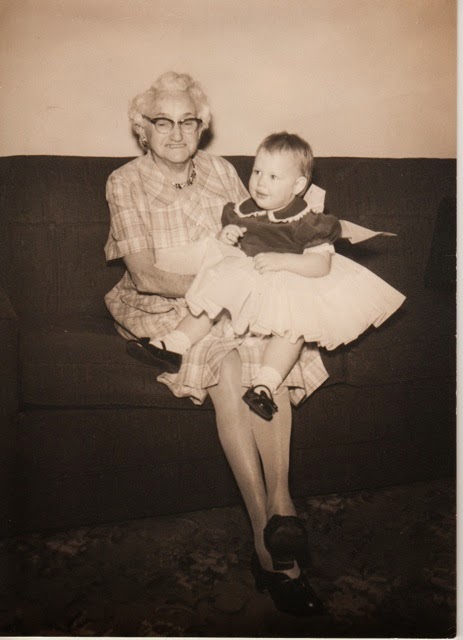
Minnie King Steele 1873-1961 Ohio
Great-great-grandma Minnie (King) Steele and me, 1961

As I looked for the earliest family member Minnie might have known, I breezed past her father and mother, Newel and Electa (Roush) King. I considered her grandfather, Gideon Roush, who lived until July 1894, when Minnie was 20 years old. Could I do better than that?

Yes. Minnie’s life overlapped with her great-grandmother, Hannah (Roush) Roush. Hannah was born December 30, 1790, and died in Cheshire Township at the age of 85 on March 26, 1876. Minnie was about two and a half years old at the time, living in the same small community. How I wish I had a photo of them together!

So with two degrees of separation, my life touched my great-great-grandmother, whose life touched her great-grandmother, who was born as the calendar turned from 1790 to 1791. That’s 223 years and counting.

Kind of boggles the mind, doesn’t it?

We are closer to history than we realize.

--Shelley

October 13, 2013

Ballenger Ancestors: Saturday Night Genealogy Fun


Randy Seaver, author of Genea-Musings, always comes up with a fun challenge each weekend. This time he prompted me to explore a genealogical numbering system I’ve never used before. Here’s his “mission”:

Your mission, should you decide to accept it (cue the Mission Impossible! music) is to:

1)  Do you know what a "Henry Number" is?  It is a descendant numbering system from a specific person. The Wikipedia article for Genealogical Numbering Systems describes it as:

"The Henry System is a descending system created by Reginald Buchanan Henry for a genealogy of the families of the presidents of the United States that he wrote in 1935.[3] It can be organized either by generation or not. The system begins with 1. The oldest child becomes 11, the next child is 12, and so on. The oldest child of 11 is 111, the next 112, and so on. The system allows one to derive an ancestor's relationship based on their number. For example, 621 is the first child of 62, who is the second child of 6, who is the sixth child of his parents.  In the Henry System, when there are more than nine children, X is used for the 10th child, A is used for the 11th child, B is used for the 12th child, and so on. In the Modified Henry System, when there are more than nine children, numbers greater than nine are placed in parentheses."

2)  Go to your first known ancestor with your birth surname and calculate your Henry Number from that person.  Show each generation of your line of ancestors with your birth surname with their Henry numbers.

3)  How did you calculate the Henry numbers?  What do these numbers tell you?

4)  Tell us in your own blog post, in a comment on this blog post, or in a Facebook or Google+ post.

My first known ancestor with my birth surname, Ballenger, is Charles Ballenger, born 29 March 1815, possibly in Fairfax County, Virginia. He lived most of his adult life in Athens County, Ohio, then moved to Delaware County, where he died 19 October 1891. According to the Henry system that Randy explained, Charles is ancestor number 1.

Here is my Ballenger line with their Henry numbers:
1             Charles Ballenger (1815-1891)
18           James Madison Ballenger (1855-1913)
181          Charles Cleveland Ballenger (1882-1953)
1813        Lloyd Russell Ballenger (1911-2002)
18132      Edward Ballenger (living)
181321    Shelley Ballenger Bishop (living)

Figuring out the Henry numbers was relatively easy, because I already have a complete list of the children in each generation. I simply went to my family database in Reunion for Mac, my software of choice, and found the birth order for each of my direct ancestors (all males, since this is my birth surname). I also consulted a previous blog post, Surname Saturday: Ballenger Family, which gives the names of everyone in the families. I had to make one decision: whether or not to count an unnamed infant who lived only four hours (she was an older sister of Lloyd Ballenger, my grandfather). I did count her, because she was a very real baby to her parents, which made Lloyd their third-born child.

The most widely accepted genealogical numbering systems today are the Register System, developed in 1870 and used by the New England Historic and Genealogical Register, and the NGSQ System, developed in 1912 by the National Genealogical Society Quarterly. The NGSQ System is sometimes called the Modified Register System. A short book published by the National Genealogical Society called Numbering Your Genealogy provides a good overview of both of these systems, and it also briefly describes the Henry System.

While I don’t think I’ll ever use the Henry System in my own research or writing, it was fun to experiment with it. I’ve read about it before, but there’s nothing like a good hands-on exercise to help me understand it. Isn’t that true of a lot of things?

--Shelley

Related Posts:

January 13, 2013

Lewis Zirkle: Saturday Night Genealogy Fun


Randy Seaver has invited us to indulge in some “Semi-Random Research” during his weekly Saturday Night Genealogy Fun at Genea-Musings, saying:

Your mission, should you decide to accept it (cue the Mission Impossible! music) is to:

1)  We're going to do a little bit of Semi-Random Research tonight...

2)  Go to your family tree database of choice (you know, like RootsMagic, Reunion, Ancestry Member Tree), and determine who the very last person on your list of names is.

3)  What do you know about this person based on your research?  It's OK to do more if you need to - in fact, it's encouraged!

4)  How are you related to this person, and why is s/he in your family tree?

5)  Tell us about it in a blog post of your own, in a comment to this blog post, or in a Facebook Status post or Google+ Stream post.

I decided to take Randy up on this challenge, because the last person in my Reunion database is from a family I haven’t written about before. His name is Lewis Zirkle, or in the original German, Zerckel. The surname is sometimes found in American records as “Circle.” Lewis is a collateral relative to me, related by marriage to my seventh-great-aunt, Mary or Magdalena Roush.

Lewis Zirkle was born about 1740 in Telford, Montgomery County, Pennsylvania.(1) He was one of several sons of Lewis Zerckel the elder, who emigrated from Germany and later migrated from southeastern Pennsylvania to the Shenandoah Valley of Virginia before the Revolutionary War, the same as Mary’s father, John Adam Roush (Johan Adam Rausch).

Lewis Zirkle the younger settled on Smith Creek in Rockingham County, Virginia, near the town of New Market. Family lore holds that he and Mary had four sons and four daughters. They remained on their Smith Creek land all their lives. At the time of Lewis’ death at age 77, he owned 1500 acres, with a tannery and a mill. He died January 22, 1815. He and Mary are buried in the graveyard of St. Matthews Lutheran Church in New Market.(2)

The National Society Daughters of the American Revolution has recognized Lewis Zirkle as a patriot for his contributions to the Revolutionary cause.(3)

The histories of the Zirkle and Roush families intertwined further with other marriages, even as descendents of both families moved westward and settled in Gallia County and Meigs County, Ohio. In studying one family, it helps to study the other. They played a big role in each other’s cast of friends, associates, and neighbors over the course of multiple generations.

Thanks for this challenge, Randy!
--Shelley

(1) Find a Grave, database and images (www.findagrave.com: accessed 11 April 2010), Lewis H. Zirkle memorial, no. 33568802, created by Jonathan Grimm on 5 February 2009, citing Saint Matthews Cemetery, New Market, Shenandoah County, Virginia.

(2) Lester L. Roush, History of the Roush Family in America, vol. 1 (Strasburg, Virginia: Shenandoah Publishing House, 1928), p. 677-682.

(3) “Ancestor Search,” Genealogical Research System database, National Society Daughters of the American Revolution (http://services.dar.org/public/dar_research/search/?tab_id=0: accessed 12 January 2013), Lewis Zirkle, ancestor no. A131098, Virginia.

December 2, 2012

My 2012 Genea-Santa Wish List


Randy Seaver issued an invitation for this week’s Saturday Night Genealogy Fun on Genea-Musings that I just can’t resist:

Come on, everybody, join in and accept the mission and execute it with precision. Here's your chance to sit on Genea-Santa's lap (virtually) and tell him your Christmas genealogy-oriented dreams:
1) Write your Genea-Santa letter. Have you been a good genealogy girl or boy? What genealogy-oriented items are on your Christmas wish list? They could be family history items, technology items, or things that you want to pursue your ancestral quest.
2) Tell us about them in your own blog post, in a comment on this post, or in a Facebook status or Google Stream post.

What am I waiting for? Let’s get this letter started!

Dear Genea-Santa,

I’ve tried to be a good girl this year, and can’t wait for your visit. I’ve volunteered my time on the boards of two local genealogical societies, put out four society newsletters, paid close attention in my classroom at GRIP, and did my homework diligently (okay, so I didn’t get the answers right, but I tried!). I've spent a lot of time trying to hook myself and other people up with our ancestors. I know this is a busy time of year, but there’s a few things I could really use, so here’s what I’d like to ask for:
  • An iPad Mini, so I can play with some fun new apps and load it up with books to read. I’ve never had a tablet or e-reader, but this one looks so darn cute and portable, and will sync with all my other devices and my Reunion database. Pretty please?
  • The digital version of Evidence Explained by Elizabeth Shown Mills, to put on the iPad Mini and my Mac. I already have a well-bookmarked copy in hardback, but the e-book will be way lighter to carry around.
  • A one-week trip to Genealogy Fantasty Island, where I can focus exclusively on my research and writing. No phone calls, no repairmen, no obligations, and—much as I love my friends and family—no visitors. Just uninterrupted time. Oh, and an instant transporter to the archives I need, too.
  • A visit from Mary Poppins. You know her, right? Remember how she and the children tidied up the nursery just by snapping their fingers? I need that, Santa. Just give me one day with Mary and I bet we can have my office, my photo collection, and my kitchen spit-spot.
  • Dinner dates with each of the three mystery men whose parents I’ve been searching for:
    • Charles Ballenger (1815-1891) of Athens County, Ohio
    • Fitch Bishop (1811-1868) of Sheffield, Massachusetts and Freedom, Ohio
    • George W. Self (c. 1805-c. 1875) of Buncombe County, North Carolina

I hope this isn’t too much to ask for, Santa. I imagine you probably get pretty tired of milk and cookies at every house, and at some point during your long journey you could use a little pick-me-up. So tell you what: I’ll set out a nice big margarita with chips and salsa for you, and some munchies for your hard-working reindeer, too. Just a little something to make your night merry and bright. Deal? Thanks, Santa!

Faithfully,
Shelley 

July 10, 2011

Elevator Pitch: 31 Weeks to a Better Blog and SNGF

Tonia Kendrick, who writes Tonia’s Roots, has started a new series of posts called “31 Weeks to a Better Genealogy Blog.” Since I’m still fairly new to blogging, and trying to figure things out as I go along, I thought it sounded like a great opportunity to learn, branch out, and spice things up a bit.

The first challenge is to write an “elevator pitch” for your blog—a short speech you can deliver in the span of a quick elevator ride. That doesn’t sound too hard, right? Well, for me it wasn’t that simple—I was still playing around with it when Randy Seaver made it the topic for this week’s Saturday Night Genealogy Fun. Sort of makes it a double challenge now!

So this is what I finally came up with: 
“Do you find the hunt for your ancestors fascinating? I do! A Sense of Family chronicles my journey into my family history. I enjoy sharing new discoveries, tips and research tools, memories, photos, and, above all, the stories of my ancestors. It’s amazing how far and wide they traveled before converging in Ohio, and how learning about them brings history to life. Once you get started, I bet you’ll find your ancestors fascinating, too!”

You can check out responses to the Elevator Pitch—or submit your own—on Tonia’s Roots. I look forward to seeing what other bloggers say and do with this!


Related Posts:
Are You Going to the FGS Conference?
Playing Catch Up with 31 Weeks to a Better Genealogy Blog
Fun Family History Books for Summer Reading

LinkWithin

Related Posts Plugin for WordPress, Blogger...