Showing posts with label Military Records. Show all posts

May 31, 2014

Jacob Roush and Philip Roush, Virginia Militiamen: 52 Ancestors

Two hundred and thirty-nine years ago (almost to the day), two of my 6th-great-grandfathers took a bold step. The spring of 1775 had brought troubled times to the American colonies. Relations with Great Britain had grown increasingly strained. In early April 1775, the battles at Concord and Lexington confirmed that there was no turning back. The rumblings of discontent had sprouted into outright confrontation, and the American Revolution was underway.

Patriots in Virginia, as in other colonies, quickly formed local militia companies to protect their homes and fight for the cause of American independence. Jacob Roush and Philip Roush were among the men who enlisted in the Dunmore County Militia, under the command of Capt. Jacob Holeman, on May 29, 1775.

I first found evidence of Jacob and Philip’s service as I worked on my application for the Daughters of the American Revolution. The DAR uses the transcription of Jacob Holeman’s enlistment roster in Revolutionary War Records Virginia by Gaius M. Brumbaugh as its source.[1] This is an excellent derivative source, and I’m grateful for it. But as genealogists, we’re urged to seek the original source whenever possible. So that’s what I did when I visited the Library of Virginia during the recent NGS 2014 Conference in Richmond.

Wow. What a thrill to see the list itself! (Even though it’s a negative photostat, and still technically a derivative, it's as close as I’m ever likely to get to the original.) Somehow, holding it made the excitement of that long-ago time, and the power of the commitment these men made, seem like a tangible thing to me. It was no small thing to fly in the face of the royal government and pledge your loyalty to the colonial militia. Their lives, and the security of their families and livelihoods, were on the line.

The two-page document is titled, “A List of the Mens Names in Dunmore County Militia under the Command of Capt. Jacob Holeman.” On the second page, after the names, is the official decree: “By Virtue of the Power and Authority to me given as Lieutenant of the County of Dunmore I do hereby Enlist the with Nam’d Men under the Command of Capt Jacob Holeman. Given under my hand this 29th day of May 1775.”[2] (I’m still working to decipher the flowery signature of the official who signed it.)

A few of my observations about the list, some of which aren’t readily apparent from the transcription in Brumbaugh’s book:
  • The men are listed in three columns. All names on the first page are written in the same clearly legible handwriting; there are no signatures. A few names are crossed out, as though they were later removed from the roster. On the second page are 15 more names, written in a different hand, that appear to have been added after the official declaration.

  • In Brumbaugh’s transcription, the names are in alphabetical order, and the last name is given first (i.e., Roush, Jacob and Roush, Philip). On the original list, the names appear to be in the order that the men presented themselves. They are not in alphabetical order, and the first name comes first, just as it would be said aloud.

  • While many of these men were German, the spellings of their names were anglicized, probably according to how the scribe heard them. Rausch, which morphed into Roush, is spelled Rouse in four places here (brothers Philip, Jacob, Henry, and John Jr.). Zirkle, commonly seen as Circle, is spelled Cirkle (Andrew, Michael, and Peter). The surname Durst, which became Darst in later generations, is spelled Dirst (Abraham and Isaac—Abraham Durst is my 7th-great-grandfather). Clearly, spellings were not yet standardized.

  • Crease lines are evident, indicating the document was folded. A portion of the second page bears the address, “To Capt. Jacob Holman Dunmore County,” as though it was to be delivered to him. (no “e” in Holman in the address)

The Library of Virginia's terms of use preclude me from posting a picture of Jacob Holeman’s List here, and I don’t want to do anything to jeopardize the chances that others have to view, photograph, and copy the document for their personal use. So I’ll share just a small portion of the list where the names of Philip, Jacob, and Henry Roush appear, to give you a sample of the beautiful handwriting. Philip’s name is just above the fold, with some wear evident.


I’ve heard we should seek the original record for the sake of accuracy and completeness. That’s fine and well, but from my experience, I’d add: do it for the sense of connection it gives you. Seeing an original document brings your family history alive in a way that a published transcription simply can’t do. And sometimes that history is just so cool, isn’t it?

--Shelley

© Copyright 2014 Shelley Bishop
The “52 Ancestors in 52 Weeks” series is coordinated by Amy Johnson Crow, CG, author of the blog No Story Too Small.

Related Posts:


[1] Gaius Marcus Brumbaugh, Revolutionary War Records Virginia (1936; reprint, Baltimore: Genealogical Publishing, 1995), p. 607-608.
[2] Shenandoah County, Virginia, Dunmore County Militia Roster, Captain Jacob Holeman’s Company, 1775; accession no. 21127, “Dunmore County Revolutionary War papers, 1775-1814,” Box 53, 2 leaves; Library of Virginia, Richmond.

January 28, 2014

Roy D. Eberhard, World War I Soldier: 52 Ancestors


For most of Roy Eberhard’s young life, there wasn’t time to consider much beyond the farm and schoolhouse. Born March 9, 1894, the second oldest of Llewellyn and Mary Eberhard’s passel of kids, he naturally shouldered responsibility for chores around his father’s dairy farm. There was always milking to be done, not to mention making deliveries, hauling water, chopping wood, and helping with the animals and feed crops.

But as Roy passed his 20th birthday, the world started to intrude. More and more news filtered into the local papers, news of hostilities and battles taking place on a distant continent. By the time he turned 23, it became all too clear that even a poor farm boy from central Ohio couldn’t avoid facing the storm in Europe.

On June 3, 1917, Roy made his way to the Orange Township draft board office in Delaware County. He registered his birth date and place, age, address, occupation, employer, and marital status, as the law required. His stature, build, and color of his eyes and hair were duly noted.1


The U.S. Army called Roy into service four months later, on October 5, 1917. My grandmother—his little sister, Nora—recalled everyone was proud of him, but her mother was worried the whole time he was gone.

Roy Eberhard Delaware County Ohio WW1
Roy Eberhard, Delaware County, Ohio, 1917

Private First Class Roy Eberhard served in the American Expeditionary Forces in France for nearly a year, from June 1918 to May 1919. He was assigned to the Headquarters Company of the 324th Field Artillery, under the command of Colonel T. Q. Ashburn.2 The 324th was a horse-drawn, heavy artillery regiment. The troops endured difficult marches in which they transported large cannons over frequently muddy roads, without motorized assistance. Once they arrived at a battle site, they moved the cannons into position and awaited orders to fire.


Pvt. Eberhard participated in the Meuse-Argonne Offensive, also known as the Battle of Argonne Forest, in fall 1918. The offensive involved over a million American and French troops under the command of General Pershing. The 324th Field Artillery was attached to the 32nd Division. According to Col. Ashburn, the 324th moved “across the Meuse at Dun, thence to Velosnes, thence into position at Bois d’Ecurey November 10th, 1918. It again attacked on the morning of November 11th, and fired retaliation fire after the armistice was announced, up to 10:25 A.M., being the last shots delivered by the 32nd Division in the war.”

The men had to wait for 600 fresh horses before starting the long trek through France and into Germany in December. They spent the winter of 1919 near the Rhine River. On April 22nd, they finally began returning home.3 Pvt. Eberhard received his honorary discharge in June.


Roy settled back into civilian life, married, and had two sons. He began a career with the railroads. With his military service and youth behind him, Roy David Eberhard probably thought the U.S. Army was done with him. Even when the news from Europe turned grim again, and young men geared up to say goodbye to their loved ones like he had two decades earlier, he could rest on the assurance that he had already done his part.

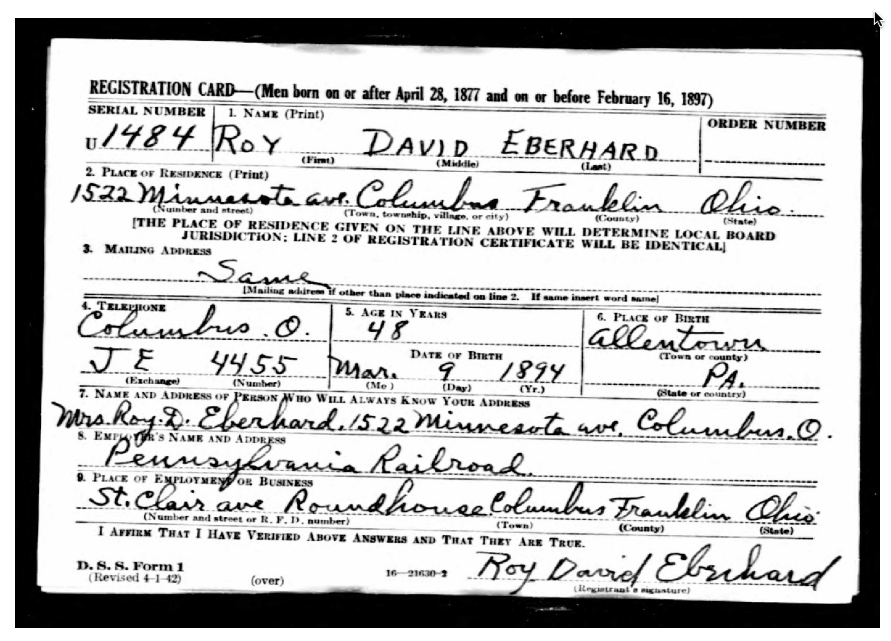
Imagine the sense of déjà vu, then, when he found himself back in front of the draft board at the age of 48.4


--Shelley

Sources:
1. “U.S. World War I Draft Registration Cards, 1917-1918,” digital image, Ancestry (www.ancestry.com: accessed 25 Jan 2014), Roy D. Eberhard (Delaware County, Ohio); U.S. Selective Service System, World War I Selective Service System Draft Registration Cards, 1917-1818, NARA microfilm publication M1509, roll 1832192.

2. Ohio Adjutant General’s Department, Official Roster of Ohio Soldiers, Sailors, and Marines in the World War, 1917-18 (F.J. Heer Printing Co., 1926), p. 4628, Roy D. Eberhard; database and digital images, “Ohio Soldiers in WWI, 1917-1918,” Ancestry (www.ancestry.com: accessed 25 Jan 2014).

3. T. Q. Ashburn, History of the 324th Field Artillery, United States Army (New York: George H. Doran Co., 1919), p. 24-25; digital copy, Internet Archive (https://archive.org/details/historyof324thfi00ashb : accessed 25 Jan 2014). Images used here appear on page 10 and page 80.

4. “U.S. World War II Draft Registration Cards, 1942,” digital image, Ancestry (www.ancestry.com: accessed 2 Nov 2013), Roy David Eberhard (Franklin County, Ohio); U.S. Selective Service System, Selective Service Registration Cards, World War II: Fourth Registration; FHL microfilm 2,372,762.

© Shelley Ballenger Bishop 2014

This is the fourth in a series of family history stories written for the blogging prompt “52 Ancestors in 52 Weeks,” coordinated by Amy Johnson Crow, CG, author of No Story Too Small.

Related Posts:

November 14, 2013

How can you tell if your ancestor might have served?


I recently put together a list of veterans in my family tree, both as a tribute to their service and a reminder to myself to research them further in military records. Someone asked me how I could tell if an ancestor was the right age to have served in a U.S. war or conflict. This is a great question, because identifying potential service is a natural first step to finding an ancestor who did serve in the military.

Fortunately, Family Tree Magazine has an excellent War Service Reference Guide available as a free download on their website, www.familytreemagazine.com. It lists the dates of every American military engagement through World War II, starting with the Powhatan Wars of 1622-1644. There’s also a handy chart showing the range of birth years for men who could have served in each major conflict, from the Revolutionary War through Vietnam. It’s a quick and indispensible one-page guide that I refer to often. To find it, click on “Research Toolkit” on the menu bar, then click on “Cheat Sheets.” Scroll down to “Record References” and you’ll find five offerings, one of which is the War Service Reference Guide.

Here’s a snapshot of the chart:

War Service Reference Guide

The information on the reference guide is taken from an article by Rick Crume that appeared in the November 2008 issue of Family Tree Magazine. Thanks to Rick and the editors of the magazine for offering this great resource free of charge. I hope you find it as helpful in your research as I have in mine.

--Shelley

Related Posts:


June 25, 2013

Finding Ohio War of 1812 Soldiers: Tuesday's Tip


Do you have an male ancestor who was born between 1762-1799, and might have been living in Ohio by 1814? If so, you may want to check the Roster of Ohio Soldiers in the War of 1812 to see if he served in the Ohio Militia during that conflict.

The Roster, compiled by the Adjutant General of Ohio in 1916, is a unique resource for identifying a potential War of 1812 soldier. Required by an act of the state’s General Assembly in 1915, the compilation includes the names of 1759 officers and 24,521 enlisted men.

Militia companies in the War of 1812 were organized by the name of the captain or lieutenant, rather than by a regiment number (as was customary during the Civil War). Most militia units were raised within a particular county, so if you find your ancestor’s name, you might also discover what county he lived in. Or if you know the county but are dealing with a common name, you can see if there's a potential match.

Here’s a sample listing of a unit I'm interested in. This is Capt. William Kendall’s Company, a cavalry unit from Scioto County: (by the way, that’s pronounced “sci” as in “sci-fi”)

Image from: Adjutant General of Ohio, Roster of Ohio Soldiers in the War of 1812
(1916; reprint, Westminster, Maryland: Heritage Books, 2007), p. 148.

The Roster of Ohio Soldiers in the War of 1812 has been reprinted in handy paperback size by Heritage Books. I have it, and like being able to browse through it in print. Most libraries with a large genealogical collection, including main county libraries in Ohio, should have it or the original hardback edition on their shelves. But for those with a subscription, it’s also available as a searchable database on Ancestry.com, with images of every page. It's nice that there are multiple ways to access the information.

Dorene Paul, the Graveyard Rabbit of Sandusky Bay, gave another good tip on finding more about the War of 1812 in Ohio in her recent post, “Battle of Lake Erie Bicentennial,” so I recommend you hop over and read it. And if you’re wondering where I got those birth years of 1762-1799 for the soldiers, I need to give full credit to Family Tree Magazine, which posted this cool graphic on its Facebook page awhile back:


That kind of gets you thinking, doesn’t it? Especially since military records can be fantastic sources of information. Could you have an ancestor who served in the Ohio Militia from 1812-1814? If so, good luck with your search!

--Shelley

Related posts:

LinkWithin

Related Posts Plugin for WordPress, Blogger...