Showing posts with label Roush genealogy. Show all posts

January 13, 2013

Lewis Zirkle: Saturday Night Genealogy Fun


Randy Seaver has invited us to indulge in some “Semi-Random Research” during his weekly Saturday Night Genealogy Fun at Genea-Musings, saying:

Your mission, should you decide to accept it (cue the Mission Impossible! music) is to:

1)  We're going to do a little bit of Semi-Random Research tonight...

2)  Go to your family tree database of choice (you know, like RootsMagic, Reunion, Ancestry Member Tree), and determine who the very last person on your list of names is.

3)  What do you know about this person based on your research?  It's OK to do more if you need to - in fact, it's encouraged!

4)  How are you related to this person, and why is s/he in your family tree?

5)  Tell us about it in a blog post of your own, in a comment to this blog post, or in a Facebook Status post or Google+ Stream post.

I decided to take Randy up on this challenge, because the last person in my Reunion database is from a family I haven’t written about before. His name is Lewis Zirkle, or in the original German, Zerckel. The surname is sometimes found in American records as “Circle.” Lewis is a collateral relative to me, related by marriage to my seventh-great-aunt, Mary or Magdalena Roush.

Lewis Zirkle was born about 1740 in Telford, Montgomery County, Pennsylvania.(1) He was one of several sons of Lewis Zerckel the elder, who emigrated from Germany and later migrated from southeastern Pennsylvania to the Shenandoah Valley of Virginia before the Revolutionary War, the same as Mary’s father, John Adam Roush (Johan Adam Rausch).

Lewis Zirkle the younger settled on Smith Creek in Rockingham County, Virginia, near the town of New Market. Family lore holds that he and Mary had four sons and four daughters. They remained on their Smith Creek land all their lives. At the time of Lewis’ death at age 77, he owned 1500 acres, with a tannery and a mill. He died January 22, 1815. He and Mary are buried in the graveyard of St. Matthews Lutheran Church in New Market.(2)

The National Society Daughters of the American Revolution has recognized Lewis Zirkle as a patriot for his contributions to the Revolutionary cause.(3)

The histories of the Zirkle and Roush families intertwined further with other marriages, even as descendents of both families moved westward and settled in Gallia County and Meigs County, Ohio. In studying one family, it helps to study the other. They played a big role in each other’s cast of friends, associates, and neighbors over the course of multiple generations.

Thanks for this challenge, Randy!
--Shelley

(1) Find a Grave, database and images (www.findagrave.com: accessed 11 April 2010), Lewis H. Zirkle memorial, no. 33568802, created by Jonathan Grimm on 5 February 2009, citing Saint Matthews Cemetery, New Market, Shenandoah County, Virginia.

(2) Lester L. Roush, History of the Roush Family in America, vol. 1 (Strasburg, Virginia: Shenandoah Publishing House, 1928), p. 677-682.

(3) “Ancestor Search,” Genealogical Research System database, National Society Daughters of the American Revolution (http://services.dar.org/public/dar_research/search/?tab_id=0: accessed 12 January 2013), Lewis Zirkle, ancestor no. A131098, Virginia.

September 12, 2011

Jacob Roush, 1803 Ohio Deed - Amanuensis Monday

An amanuensis is a person employed to write what another dictates or to copy what has been written by another. Amanuensis Monday is a genealogy blogging theme popular for the transcription of family letters and documents.


My sixth-great-grandfather, Jacob Roush, bought this parcel of land on March 4, 1803—just three days after the Ohio General Assembly met for the first time in Chillicothe to officially declare Ohio’s statehood. The deed indicates that Jacob was already a resident of Washington County, but I have yet to determine exactly where he was living prior to this purchase. I do know that his daughter, Catharine Roush, was married to Peter Lallance in Marietta (the county seat) in January 1799. Washington was the parent county out of which Gallia County was formed.


[in margin]  


James Munro by his attorney Benj. Ives Gilman to Jacob Roush

Recorded 12th July 1804

Know all men by these Presents I James Munro of Providence in the State of Rhode Island, Gentleman, for in consideration of the sum of Four hundred dollars to me is here paid before the ensealing hereof by Jacob Roush of the County of Washington and State of Ohio, Yeoman, have bargained & sold & by these Presents bargain & sell to the said Jacob Roush his heirs & assigns, the one hundred acre lot n. °745 drawn in my name lying in Township No. 5 in the 14th Range of the Ohio Companies purchase bounded as follows viz. North on lot No. 398 drawn in the name of Abijah Hammond, South on land sold by the Ohio Company to Jonathan Stone, East on the Ohio River and west on Section No. 8 being a reserved Congress lot, all which will more fully appear by the [?] & Records of the Ohio Company reference thereunto being had. __To have & to hold the said Grantee Premises with the appurtenances to him the said Jacob Roush his heirs and assigns in fee simple forever, and I the said James Munro do promise & oblige myself my Heirs Executors & administrators to warrant & defend the above granted Premises against the Claim & Demands of any person or persons whomever.__In witness whereof I have hereunto set my hand & seal this Fourth day of March in the year of our Lord one thousand eight hundred & three__James Munro by his attorney Benj. Ives Gilman. Signed Sealed & Delivered in presence of William Parker, J
                                             Page 70
William Parker Junr[,] Joseph Gilman___ Washington County State of Ohio, Marietta 4th March 1803, Benjamin Ives Gilman personally appearing acknowledged the foregoing Instrument by him subscribed as agent for James Munro, to be his Voluntary act & Deed, before Joseph Gilman one of the Judges of Territory of the United States north west of the River Ohio.

Citation: Gallia County, Ohio, Deed Book 1: 69-70, James Munro to Jacob Roush, recorded 12 July 1804, Recorder’s Office, Gallipolis; Family History Library microfilm 317,675. 

Related Posts:

August 27, 2011

Roush Family Ancestry - Surname Saturday

The Roush (Rausch) & Allied Families of America recently held their 83rd Annual Reunion, celebrating the 300th anniversary of the birth of John Adam Roush. Although I was unable to attend this year, I did go to the 2010 Roush Reunion in Akron, Ohio, and had a wonderful time meeting many new cousins. I am a descendant of two of John Adam’s sons, Philip and Jacob. Here's a brief overview of my Roush ancestry:

Generation 1
John Adam Roush (Johan Adam Rausch), born about 1711 near Darmstadt, Hesse, Germany; immigrated to Philadelphia in 1736; died 19 October 1786 in Shenandoah County, Virginia. He married Susanna Sehler. She was born about 1713 in Germany, and died in 1796 in Shenandoah County. They had at least 10 children: Philip, Henry, John, Jacob, Daniel, Eleanor, Mary, Elisabeth, George, and Jonas.

Generation 2
Philip Roush, born about 1741 in Pennsylvania or Virginia; served in the Dunmore County Virginia Militia during the Revolutionary War; died 1 March 1820 in Gallia County, Ohio. He married Catharine Kelchner about 1764. She died in 1833 in Gallia County. They had 13 children: John, Elizabeth, Susanna, Michael, Philip, Catherine, Henry, Sarah, Molly, Eva, George, Hannah, and Jonas.

Jacob Roush, born about 1746 in Pennsylvania or Virginia; served in the Dunmore County Virginia Militia during the Revolutionary War; died in 1830 in Gallia County, Ohio. He married Catharine Fox on 21 February 1775 in Dunmore [Shenandoah] County, Virginia. She was born about 1758, and died before 1827 in Gallia County. They had 8 children: Rosanna, Dorothy, Catharine, John, Adam, Susanna, Paul, and Cornelius.

Generation 3
Adam Roush (son of Jacob), born 29 November 1785 in Shenandoah County, Virginia; died in 1846 in Gallia County, Ohio. He married Hannah Roush (daughter of Philip) on 12 April 1808 in Athens County, Ohio. She was born 30 December 1790 in Shenandoah County; died 26 March 1876 in Gallia County. They had 3 children: William, Gideon, and Lydia.

Generation 4
Gideon Roush, born 11 September 1812 in Gallia County, Ohio; died 31 July 1894 in Gallia County. He married Elizabeth Rayburn on 2 March 1837 in Gallia County. She was born 18 March 1815 in Virginia, and died 22 April 1855 in Gallia County. They had 8 possible children: Admiral Rodney, Benjamin, Adam, Wilson, Electa, Abner, William, and James.

Generation 5
Electa Roush, born 11 August 1845 in Gallia County, Ohio; died 30 June 1932 in Dayton, Montgomery County, Ohio. She married Newel King on 26 May 1869 in Mason County, [West] Virginia. He was born 17 January 1838 in Gallia County, served in Co. B, 91st Ohio Volunteer Infantry during the Civil War, and died 17 September 1896 in Gallia County. They had 4 children: Wesley Berlin, Curtis Walden, Minnie, and Bella.

If you are a Roush descendant or are researching Roush genealogy, please contact me at sbishop@asenseoffamily.com. I have extensive documentation on the families listed here, and would welcome the chance to share my sources and collaborate our findings.

August 9, 2011

Gideon Roush and Elizabeth Rayburn - Tombstone Tuesday


     GIDEON ROUSH
           BORN
     SEPT. 11, 1812
            DIED
      JULY 31, 1894


     Roush Cemetery
     Cheshire Township
     Gallia County, Ohio

.


Gideon was my fourth great-grandfather. The son of Adam and Hannah Roush, he was born in Ohio, most likely on land very near where he was buried 81 years later.

Gideon married Elizabeth Rayburn on March 2, 1837 in Gallia County (Gallia County, Ohio, Marriage Records, vol. 1, p. 447, Probate Court Office, Gallipolis). Although she predeceased him by almost 40 years, they were buried together. Her inscription is on the other side of their shared tombstone. 


    ELIZABETH RAYBURN
            WIFE OF
        GIDEON ROUSH
              BORN
        MAR. 18, 1815
               DIED
        APRIL 22, 1855


Related Posts:

April 10, 2011

Newel King, 91st Ohio Volunteer Infantry


By the summer of 1862, with war sweeping the nation and hopes for a quick and easy end to hostilities fading, the Ohio River became more than just a symbolic dividing line between North and South. The river counties on the Ohio side braced for the possibility of invasion. Ohio Governor David Tod issued a call for 300,000 men in early July 1862, followed by a call for an additional 300,000 men just a month later. This sense of urgency heralded the 91st Ohio Volunteer Infantry, with recruits from six southern Ohio counties, into hasty formation.

Newel King, my third-great-grandfather, answered Tod’s call on August 6, 1862. He and his younger brother, Wesley, enlisted in their hometown of Cheshire in Gallia County, Ohio, which borders the river along its entire eastern edge. It couldn’t have been easy for Newel to take that step. His father, Newel King Sr., had died in 1853, leaving his mother widowed with 15 children. By 1860, 22-year-old Newel was the oldest child still at home, in charge of helping his mother, Clarissa, run the farm and support seven siblings. But this was the Ohio Valley’s time of need. Newel and Wesley were assigned as privates to Company B, mustering in at Camp Ironton on September 7, 1862.

View of the Ohio River from Gallipolis
Only a week later, the regiment crossed the river into Point Pleasant, Virginia. The 91st OVI marched off to its first raid against the Confederates in Buffalo, Virginia on September 26th. After a little more activity, the new recruits spent their first winter in the mountains of Fayetteville, Virginia. In the spring, as they skirmished to protect the Kanawha Valley, they were no doubt bolstered by the news of West Virginia’s admittance into the Union. Following a fairly quiet summer and early fall, the regiment engaged in a campaign against the rebel forces in Lewisburg, West Virginia, in early November. After burning the enemy’s winter quarters and commissaries, without incurring any casualties, the men of the 91st O.V.I. returned to Fayetteville for a second winter.

Throughout this time, Newel’s service record indicates only that he was “present.” But as the company prepared to move out in the spring of 1864, Newel contracted measles. He was marked “Sick in Hospital” at Fayetteville in March, April, and May. In early June, while his company (including Wesley) pushed through Virginia in a series of battles, Newel was transferred to the U.S. General Hospital in Gallipolis, Ohio.

The regimental surgeon, John Warwick, M.D., later testified how Newel became ill: “About the middle of March 1864 the said Regiment made a reconnaissance in force to Summersville West Va. The roads were very bad & the weather very severe. On this march the said Newel King broke out with measles and returned with his Regiment to Fayetteville West Va. and was placed in Regimental Hospital. He soon recovered so he could walk out to his meals. About this time our rooms were crowded with sick and he being much better had to give up his room & was placed in a cold, open shed. The night he was placed there was a fearful stormy night; morning found him covered with snow & very cold. From this exposure he contracted Inflammatory Rheumatism, was helpless & had to be handled as a child, could not move hand or feet. We were ordered from Fayetteville about May 1st 1864 at which time the said Newel King was sent to Gen. Hospital at Charleston West Va.”
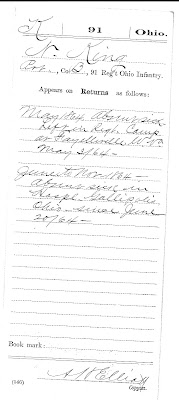

Newel recalled that after spending about two weeks in at the hospital in Charleston, he was sent to the hospital at Gallipolis, where he remained until November. While there, his “back and limbs were swollen and much afflicted.” Feeling better at last, he obtained a furlough to go home for 15 days around November first, in order to vote in the Presidential election. But that was far from the end of his troubles. His mother and sisters recalled that, while home on furlough, Newel “was stricken down with a fit of Epilepsy which continued some little time.” He returned to the hospital but, despite the seizures, was soon released.

Newel rejoined his company in Fayetteville in December. His illness, however, prevented him from resuming active duty. As company Captain John Hamilton later testified, “Newel King had not then fully recovered his health, but was able to do light camp duty, to which service I put him, and in which he continued until the discharge of the Regiment from service in June, 1865.”

During Newel’s absence, the 91st O.V.I. had fought valiantly in numerous battles in Virginia throughout the summer and fall of 1864. Wesley had been promoted to Corporal. As the final weeks of the war played out in early 1865, the regiment kept on the move but saw little military engagement. They were stationed in Winchester, Virginia when General Robert E. Lee surrendered. On June 24, 1865, both Newel and Wesley King mustered out with their company at Cumberland, Maryland, and returned home to Gallia County.

After the war, Newel married twice. His first wife, Mary Gross, died five months after the wedding. His second wife, Electa Roush, whom he married May 9, 1869, had four children and eventually became my third-great-grandmother. Although Newel farmed his land until 1892, he suffered continually from seizures and poor health.

Newel died September 17, 1896, in Cheshire Township, Gallia County, where he had been born 58 years earlier. His obituary noted, “Mr. Newell King of Cheshire, an old Ninety-Firster and a most excellent gentleman, departed this life at 3 o’clock Wednesday morning, leaving a wife and four grown children to mourn their irreparable loss. He had long been ill with that dreadful malady, consumption, and his sufferings, though dreadful, were borne with that resignation that bespeaks the Christian character.”

A most excellent gentleman indeed, and one whose story I'm glad to have the chance to tell.

SOURCES:
For regimental history: Lois J. Lambert, 91st Ohio Volunteer Infantry (Milford, Ohio: Little Miami Publishing Co., 2005).
For family information: 1860 U.S. census, Cheshire Twp., Gallia Co., Ohio, p. 95, dwelling 710, family 656: Clarissay King; digital image, Ancestry.com, citing NARA microfilm M653, roll 966. 
For service record: Compiled service record, Newel King, Pvt., Co. B, 91st Ohio Infantry; Carded Records, Volunteer Organizations, Civil War; records of the Adjutant General’s Office, 1782-1917, Record Group 94, National Archives, Washington, D.C.
For pension record: Invalid pension application no. 223,493, Newel King, certificate no. 186,803 (Pvt. Co B, 91st Ohio Infantry, Civil War); Case Files of Approved Pension Applications, 1961-1934; Civil War and Later Pension Files, Dept. of Veteran’s Affairs, Record Group 15, National Archives, Washington, D.C.
For marriage: Mason County, West Virginia, marriage records, book 6, p. 55 (1869), Newel King and Electa A. Roush, Mason County Clerk's Office, Point Pleasant.
For obituary: Newel King obituary, The Republican-Herald, Middleport, Ohio, 25 September 1896, p. 6, col. 1.
For map of Ohio: Gallia County Economic Development Office (www.growgallia.com)

Copyright by Shelley Bishop, 2011

March 1, 2011

Memories of an Ordinary Woman

Wilma Steele Herrel, my grandmother, was just an ordinary woman. She wasn’t widely known, didn’t break any great barriers, and never achieved something that might be considered particularly exceptional. She was a wife, a mother, and a grandmother; a church volunteer, a community member, a card player, and a friend. You might have seen her at the grocery store or the church rummage sale and looked right past her. But only if you didn’t know her, because if you did, you'd stop and chat, and your day would be all the happier for it.
Wilma & Fred Herrel, Nov. 23, 1935

Wilma was born in 1916 to Homer and Emma (Schiebel) Steele. She grew up in an assortment of rented houses—14 of them, by her own count—on the southeast side of Columbus, Ohio. She never forgot the day her eight-year-old little brother, Billy, died in a fire that he and a friend accidentally set in their basement. She did well in school, consistently placing on the Honor Roll, and graduated from South High. In November 1935, she and her sweetheart, Fred Herrel, eloped to Circleville and got married on the day of the OSU-Michigan game. She loved to tell how the pastor, listening to the game on the radio, quickly squeezed the ceremony in during halftime. They were both lifelong Buckeye fans after that.

But starting a new life together during the Depression, at 19 years old, couldn’t have been easy. Wilma went to comptometer school and was hired by White Castle, making $18 a week. She worked hard, excited to be earning a paycheck, and was the first local girl promoted to bookkeeper. Fred got a job as an aircraft assembler with Curtiss-Douglas. They saved all the money they could to put a down payment on a little house on the south side of the city. Several years later, Wilma quit her job three months before her first baby was born. Two more little ones followed.

For the next 25 years and beyond, she cooked all their meals. She made her own pickles, noodles, and pies. She took countless potluck dishes to church and social events. Her kitchen always smelled like hamburgers frying or cookies baking. She never had a big dining room table, or a dining room at all, as far as I know. Long after their move to Millersport in the 1960’s, we still ate at the same laminate-topped kitchen table she raised her family on.

Wilma was handy with a needle. She sewed her family’s clothes, did the mending, crocheted afghans, and made all sorts of decorative and (mostly) useful knick-knacks. Cross-stitching, knitting, quilting, you name it—she always had a project going. Her hands were never idle. Nor was her mind. She loved a good game of Scrabble, cards, dominoes, or (my personal favorite) Rack-o. She kept crossword puzzle and word search books tucked into the davenport, where her poodle liked to sleep.

I used to spend a week every summer at their house on the towpath of Buckeye Lake, going to Vacation Bible School at First Community Church. I slept on the pull-out sofa in the second bedroom, where I kept a box of treasured paper dolls stashed in the closet. One summer, when I had outgrown Bible School, Grandma showed me an old book. It had her name and birthday in it. I was entranced. For the rest of the week, while she cooked and cleaned and answered my questions, I poured over The History of the Roush Family in America. I even made a list of my ancestors going back six generations (which I still have, though I realize now I muddled up one of them). And so the seeds that would eventually grow into a passion for genealogy were planted.

Wilma was proud to be a member of the Daughters of the American Revolution. Even though I had to provide all new documentation when I submitted my own application decades later, she paved the way for me. She worked the Millersport Lions Club booth at the Sweet Corn Festival every year. She enjoyed having family visit, playing cards with friends, and traveling. She and Fred were married for 66 years before death separated them, two months apart, in 2002.

My grandmother was just an ordinary woman who cared for her family, kept her household running, and volunteered her time and talents. Her name will never appear in a history book. But I can’t help feeling that ordinary women like her are the unsung heroes of American life. And that each one, in her own way, is so very special. Thank you, Grandma, for being you.


Written for the 103rd Carnival of Genealogy, “Women’s History,” hosted by Jasia of Creative Gene. All rights reserved by Shelley Bishop, 2011.

The History of the Roush Family in America, Volume 1, was written by Lester Leroy Roush and published by the Shenandoah Publishing House (Strasburg, Virginia) in 1928. 

October 28, 2010

Musings on my 18th Century German Immigrant


I was fortunate to hear Marianne Wokeck, historian and author of the book Trade in Strangers: The Beginnings of Mass Migration to North America, at the recent Ohio Chapter Palatines to America fall seminar. Wokeck gave a fascinating presentation about German immigrants in the 18th and early 19th centuries. Since I have an ancestor, John Adam Roush, who came to Philadelphia in 1736, I found her talk especially interesting.

Among other things, I learned that about a third of the immigrants coming from the Rhineland to America in those years chose to sign a contract for indentured service in order to pay for their transatlantic fare. These immigrants faced a lot of challenges, and their decision to make a new life in a new land wasn’t an easy one. They had to learn the social customs, business practices, and language of America, and secure food, housing, and other necessities for their families. Agreeing to a period of indentured service not only paid for the journey (which was quite expensive), but also made it easier to do these things.

Unfortunately, very few written records about indentured servants, or “redemptioners” as they were called, have survived. Wokeck suggested checking court records (for a possible contract dispute) and business records in and around Philadelphia for a possible connection. I hope to be able to do that soon.

Johan Adam Rausch, as he was known then, was in his early twenties in 1736. If he was young and healthy, and hadn’t yet saved up a lot of money, might he have opted to spend a few years as an indentured servant in exchange for a start in Pennsylvania? Maybe, maybe not. Will I ever know for sure? To be honest, probably not. Does it matter? No, not really—but it sure would be interesting to find out! One thing’s for sure: since Wokeck’s presentation, I have a new respect for these hard-working early German immigrants, and the choices they had to make. 

LinkWithin

Related Posts Plugin for WordPress, Blogger...